---
key: mechanic/puzzle--family-physics
type: mechanic
id: puzzle--family-physics
lang: en
title: 'Forces, supports and movement'
summary: >-
The player reaches a target state through physical interactions among objects
and supports.
updatedAt: '2026-10-22'
status: active
url: 'https://gamemechanics.pro/en/knowledge/mechanic/puzzle--family-physics/'
jsonUrl: >-
https://gamemechanics.pro/api/v1/knowledge/en/mechanic/puzzle--family-physics.json
markdownUrl: >-
https://gamemechanics.pro/content/knowledge/en/mechanic/puzzle--family-physics.md
aliases:
- 'Forces, supports and motion'
tags:
- Puzzles
- Mechanics catalog
sourceIds:
- source-8a3a7e105b6c798e
sources:
- id: source-8a3a7e105b6c798e
title: Portal
url: 'https://store.steampowered.com/app/400/'
verifiedAt: null
relations: []
placements:
- catalogId: puzzle
id: family-physics
title: Puzzles
url: 'https://gamemechanics.pro/en/mechanics/puzzle/#family-physics'
categoryIds:
- section-1
supersededBy: []
attributes:
preview:
updatedAt: '2026-10-22'
title: 'Forces, supports and motion'
description: >-
The player reaches a target state through physical interactions among
objects and supports.
image:
src: images/mechanics/adventure-portal-04.webp
width: 640
height: 360
game: Portal
sourceUrl: 'https://store.steampowered.com/app/400/'
originalUrl: >-
https://shared.akamai.steamstatic.com/store_item_assets/steam/apps/400/0000002586.1920x1080.jpg?t=1745368554
credit: Valve
rights: >-
Game imagery © its respective rights holders. Publisher-distributed
Steam screenshot; all rights reserved. Excluded from MIT and CC BY 4.0.
caption: A cube holds a button down with its weight
alt: A cube holds a button down with its weight
markers:
- x: 80
'y': 53
label: The support transfers the cube’s weight to the button
tips:
- Match visible object contact to the actual physics rule.
examples:
- title: Portal
url: 'https://store.steampowered.com/app/400/'
endsAt: null
provenance: >-
Original editorial design catalog consolidated from project discussions on
2026-10-20. Complete discussion item lists and contextual limitations are
preserved; linked primary sources support specific techniques, not the entire
classification. English translation was prepared with machine assistance and
editorial review.
license: CC-BY-4.0
codeLicense: MIT
attribution: gamemechanics.pro contributors
catalogKey: catalog/puzzle
---
# Forces, supports and movement
id: puzzle--family-physics
type: mechanic
key: mechanic/puzzle--family-physics
lang: en
status: active
url: https://gamemechanics.pro/en/knowledge/mechanic/puzzle--family-physics/
The player reaches a target state through physical interactions among objects and supports.
## At a glance
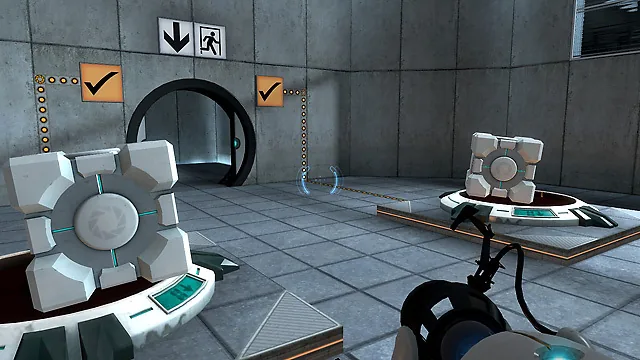
[Portal](https://store.steampowered.com/app/400/) · Game imagery © its respective rights holders. Publisher-distributed Steam screenshot; all rights reserved. Excluded from MIT and CC BY 4.0.
1. The support transfers the cube’s weight to the button
- Match visible object contact to the actual physics rule.
- [Portal](https://store.steampowered.com/app/400/)
## How it works
Receive the target state from the physical interaction of objects.
## Variants
### Variants and applications
- Fall control. Definition: Create an order of falls that will deliver the object to the target. Conditional example: Remove the support under the desired load.
- Changing the direction of gravity. Definition: Change the direction of the general fall for characters and objects. Conditional example: Throw a load from the wall to the ceiling.
- Static balance. Definition: Place masses and supports so that the structure remains stable. Conventional example: Hold the platform horizontally with two weights.
- Transfer of the center of mass. Definition: To change the distribution of mass to tip, roll or hold. Conventional example: Pour a load inside a figure so that it goes over the edge.
- Levers and power transmission. Definition: Select the location of the shoulders and mechanisms for the desired movement. Conditional example: Lift a heavy door with a light counterweight.
- Inertia and impulse. Definition: Obtain the desired movement through acceleration, deceleration and impulse transfer. Conditional example: Accelerate the cart to the far platform.
- Trajectory calculation. Definition: Select the angle, force or initial launch position. Conditional example: Hit the target with a projectile after rebound.
- Cutting ties. Definition: Choose the order of removing the hangers, taking into account swinging and falling. Conditional example: Cut two ropes in the required sequence.
- Physical chain reaction. Definition: Build a sequence of collisions and triggers. Conditional example: Launch a ball that will activate several levers. Terms: Rube Goldberg.
- Attraction and repulsion. Definition: Move bodies through changes in poles and locations of force sources. Conditional example: Pass a metal ball between magnets.
- Buoyancy. Definition: Change the density, volume or level of a liquid to move a body. Conditional example: Raise a platform by filling a reservoir.
- Friction and adhesion. Definition: Changing surfaces and contact to allow or stop movement. Conventional example: Covering an inclined path with non-slip areas.
- Drawing a physical object. Definition: Create a shape that will become a body, support or constraint in the simulation. Conventional example: Draw a hook holding a rolling ball.
- Construction of the supporting system. Definition: Assemble a structure that can withstand given loads in the accepted physics model. Conditional example: Build a bridge from a limited number of beams.
## Context and limits
A wide catalog of mechanics for digital puzzles, paper logic problems and physical puzzles. Each position contains an action or rule and a conditional example of application.
## Connected materials
## Sources and provenance
Original editorial design catalog consolidated from project discussions on 2026-10-20. Complete discussion item lists and contextual limitations are preserved; linked primary sources support specific techniques, not the entire classification. English translation was prepared with machine assistance and editorial review.
- [Portal](https://store.steampowered.com/app/400/) (id: source-8a3a7e105b6c798e)
CC-BY-4.0 · gamemechanics.pro contributors