---
key: mechanic/phone-microphone--family-timbre
type: mechanic
id: phone-microphone--family-timbre
lang: en
title: 'Timbre, articulation and manner'
summary: >-
Spectral structure, onset and articulation can distinguish sound forms. The
shown spectrum makes input-signal features observable.
updatedAt: '2026-10-22'
status: active
url: >-
https://gamemechanics.pro/en/knowledge/mechanic/phone-microphone--family-timbre/
jsonUrl: >-
https://gamemechanics.pro/api/v1/knowledge/en/mechanic/phone-microphone--family-timbre.json
markdownUrl: >-
https://gamemechanics.pro/content/knowledge/en/mechanic/phone-microphone--family-timbre.md
aliases:
- Timbre and articulation
tags:
- Phone microphone interactions
- Mechanics catalog
sourceIds:
- source-a3f4070f5ea12d71
- source-2a01d488bdebda56
- source-bdbe910fe2426deb
sources:
- id: source-a3f4070f5ea12d71
title: 'Apple: Set up speech recognition on your device'
url: 'https://developer.apple.com/videos/play/wwdc2023/10101/'
verifiedAt: null
- id: source-2a01d488bdebda56
title: 'Google MediaPipe: Audio Classification'
url: >-
https://developers.google.com/edge/mediapipe/solutions/audio/audio_classifier
verifiedAt: null
- id: source-bdbe910fe2426deb
title: phyphox
url: 'https://apps.apple.com/us/app/phyphox/id1127319693?uo=4'
verifiedAt: null
relations: []
placements:
- catalogId: phone-microphone
id: family-timbre
title: Phone microphone interactions
url: 'https://gamemechanics.pro/en/mechanics/phone-microphone/#family-timbre'
categoryIds:
- section-1
supersededBy: []
attributes:
preview:
updatedAt: '2026-10-22'
title: Timbre and articulation
description: >-
Spectral structure, onset and articulation can distinguish sound forms.
The shown spectrum makes input-signal features observable.
image:
src: images/mechanics/sensor-phyphox-3.webp
width: 663
height: 1440
crop:
x: 0
'y': 88
width: 663
height: 867
game: phyphox
sourceUrl: 'https://apps.apple.com/us/app/phyphox/id1127319693?uo=4'
originalUrl: >-
https://is1-ssl.mzstatic.com/image/thumb/PurpleSource221/v4/97/4c/8c/974c8c83-6b57-a61d-6f00-26079b8534e6/iphone-04-audio-spectrum.png/720x1560bb.jpg
credit: RWTH Aachen University
rights: >-
© RWTH Aachen University. Developer-distributed App Store screenshot.
All rights reserved; excluded from MIT and CC BY 4.0.
caption: 'phyphox: a spectrum shows the sound’s frequency structure over time'
alt: 'phyphox: a spectrum shows the sound’s frequency structure over time'
markers:
- x: 52
'y': 43
label: Bands represent energy distributed across frequencies
tips:
- Test features across microphones and distances from the phone.
examples:
- title: phyphox
url: 'https://apps.apple.com/us/app/phyphox/id1127319693?uo=4'
endsAt: null
provenance: >-
Original editorial design catalog consolidated from project discussions on
2026-10-20. Complete discussion item lists and contextual limitations are
preserved; linked primary sources support specific techniques, not the entire
classification. English translation was prepared with machine assistance and
editorial review.
license: CC-BY-4.0
codeLicense: MIT
attribution: gamemechanics.pro contributors
catalogKey: catalog/phone-microphone
---
# Timbre, articulation and manner
id: phone-microphone--family-timbre
type: mechanic
key: mechanic/phone-microphone--family-timbre
lang: en
status: active
url: https://gamemechanics.pro/en/knowledge/mechanic/phone-microphone--family-timbre/
Spectral structure, onset and articulation can distinguish sound forms. The shown spectrum makes input-signal features observable.
## At a glance
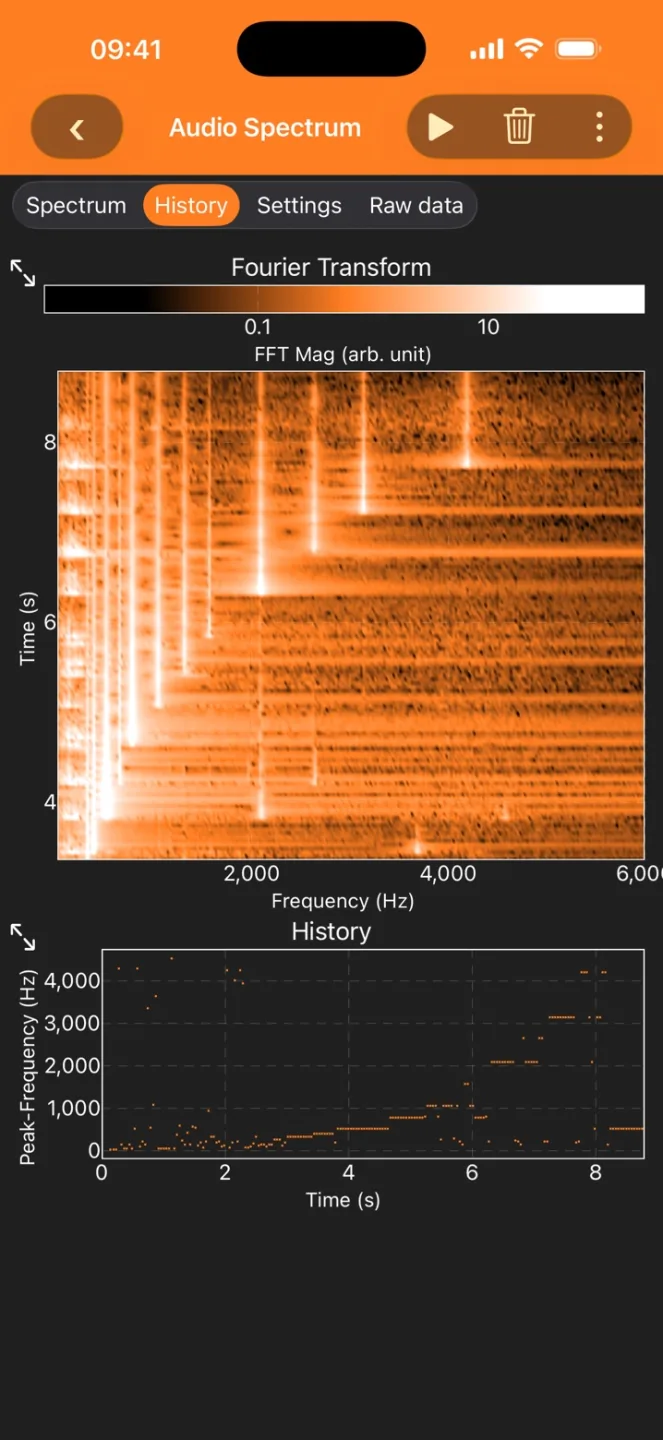
[phyphox](https://apps.apple.com/us/app/phyphox/id1127319693?uo=4) · © RWTH Aachen University. Developer-distributed App Store screenshot. All rights reserved; excluded from MIT and CC BY 4.0.
1. Bands represent energy distributed across frequencies
- Test features across microphones and distances from the phone.
- [phyphox](https://apps.apple.com/us/app/phyphox/id1127319693?uo=4)
## How it works
To distinguish sounds, you need spectral analysis rules or a trained model. The manner of performance is a game input.
## Variants
### Variants and applications
- Vowels are like buttons. Signal: Classes “a”, “o”, “y”, “i”. Application: Change the character's shape with different vowels. Access level: Recognition.
- Consonants and syllables. Signal: Limited set of “pa”, “ta”, “ka”. Application: Receive several shock commands without full speech recognition. Access level: Recognition.
- Voiced and noisy sound. Signal: Periodicity and spectrum. Application: Turn on the magnet with a hum, cool the mechanism with hissing. Access level: Recognition.
- Whistling and buzzing. Signal: A type of sustained sound. Application: Call a companion by whistling, control a heavy mechanism by humming. Access level: Recognition.
- Whispers and normal speech. Signal: Acoustic cues of manner. Application: Transmit a hidden command only in a whisper. Access level: Recognition.
- Roars, laughter and other vocalizations. Signal: Pre-selected classes of non-speech sounds. Application: Depict characters or cause different reactions of a creature. Access level: Recognition.
- Imitation of a model. Signal: Similarity to the recorded reference. Application: Depict a bird, robot or fantastic animal. Access level: Recognition.
- Expressive presentation. Signal: Tempo, pitch, pauses, accents. Application: Play the role of a speaker or actor on an explicit scale of performance, without “reading feelings”. Access level: Recognition.
## Context and limits
Author's design map for mobile games and interactive applications. 144 techniques in 18 groups, including basic signals, rules and combinations. Applications are design ideas and not a list of released games.
## Connected materials
## Sources and provenance
Original editorial design catalog consolidated from project discussions on 2026-10-20. Complete discussion item lists and contextual limitations are preserved; linked primary sources support specific techniques, not the entire classification. English translation was prepared with machine assistance and editorial review.
- [Apple: Set up speech recognition on your device](https://developer.apple.com/videos/play/wwdc2023/10101/) (id: source-a3f4070f5ea12d71)
- [Google MediaPipe: Audio Classification](https://developers.google.com/edge/mediapipe/solutions/audio/audio_classifier) (id: source-2a01d488bdebda56)
- [phyphox](https://apps.apple.com/us/app/phyphox/id1127319693?uo=4) (id: source-bdbe910fe2426deb)
CC-BY-4.0 · gamemechanics.pro contributors