---
key: mechanic/phone-haptics--family-multi
type: mechanic
id: phone-haptics--family-multi
lang: en
title: Multiplayer and social interaction
summary: >-
In the VibeComm prototype vibrations carry a command through a shared surface.
Phones receive it through accelerometers and change their screens together.
updatedAt: '2026-10-22'
status: active
url: 'https://gamemechanics.pro/en/knowledge/mechanic/phone-haptics--family-multi/'
jsonUrl: >-
https://gamemechanics.pro/api/v1/knowledge/en/mechanic/phone-haptics--family-multi.json
markdownUrl: >-
https://gamemechanics.pro/content/knowledge/en/mechanic/phone-haptics--family-multi.md
aliases:
- Shared cues and commands
tags:
- Phone haptics
- Mechanics catalog
sourceIds:
- source-5865614b12aed6d1
sources:
- id: source-5865614b12aed6d1
title: VibeComm (research prototype)
url: 'https://pmc.ncbi.nlm.nih.gov/articles/PMC4279528/'
verifiedAt: null
relations: []
placements:
- catalogId: phone-haptics
id: family-multi
title: Phone haptics
url: 'https://gamemechanics.pro/en/mechanics/phone-haptics/#family-multi'
categoryIds:
- section-1
supersededBy: []
attributes:
preview:
updatedAt: '2026-10-22'
title: Shared cues and commands
description: >-
In the VibeComm prototype vibrations carry a command through a shared
surface. Phones receive it through accelerometers and change their screens
together.
image:
src: images/mechanics/haptic-vibecomm-17.webp
width: 710
height: 428
crop:
x: 244
'y': 5
width: 222
height: 170
game: VibeComm (research prototype)
sourceUrl: 'https://pmc.ncbi.nlm.nih.gov/articles/PMC4279528/'
originalUrl: >-
https://cdn.ncbi.nlm.nih.gov/pmc/blobs/ec0e/4279528/93d7cc4d9b2a/sensors-14-21151f17.jpg
credit: Inhwan Hwang / Jungchan Cho / Songhwai Oh
rights: >-
Figure 17 © 2014 Inhwan Hwang, Jungchan Cho and Songhwai Oh. CC BY 4.0:
https://creativecommons.org/licenses/by/4.0/. Cropped and converted to
WebP; research prototype, not a universal phone feature.
caption: 'VibeComm: research prototype sending one command to multiple phones'
alt: 'VibeComm: research prototype sending one command to multiple phones'
markers:
- x: 58
'y': 28
label: Receivers display the same result after receiving the command
tips:
- >-
This is a low-rate experimental channel requiring a shared surface and
calibration.
examples:
- title: VibeComm (research prototype)
url: 'https://pmc.ncbi.nlm.nih.gov/articles/PMC4279528/'
endsAt: null
provenance: >-
Original editorial design catalog consolidated from project discussions on
2026-10-20. Complete discussion item lists and contextual limitations are
preserved; linked primary sources support specific techniques, not the entire
classification. English translation was prepared with machine assistance and
editorial review.
license: CC-BY-4.0
codeLicense: MIT
attribution: gamemechanics.pro contributors
catalogKey: catalog/phone-haptics
---
# Multiplayer and social interaction
id: phone-haptics--family-multi
type: mechanic
key: mechanic/phone-haptics--family-multi
lang: en
status: active
url: https://gamemechanics.pro/en/knowledge/mechanic/phone-haptics--family-multi/
In the VibeComm prototype vibrations carry a command through a shared surface. Phones receive it through accelerometers and change their screens together.
## At a glance
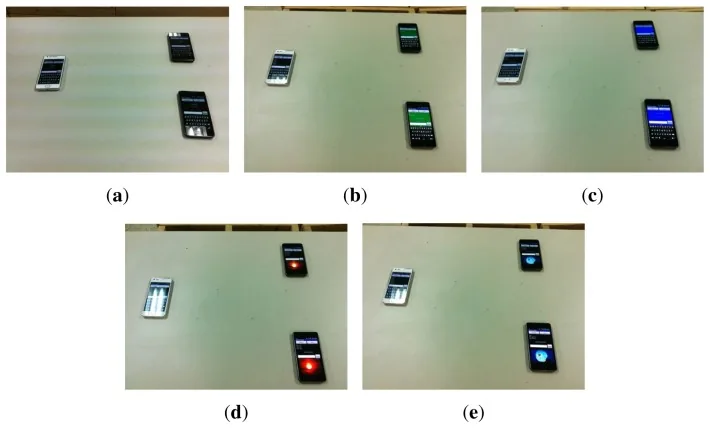
[VibeComm (research prototype)](https://pmc.ncbi.nlm.nih.gov/articles/PMC4279528/) · Figure 17 © 2014 Inhwan Hwang, Jungchan Cho and Songhwai Oh. CC BY 4.0: https://creativecommons.org/licenses/by/4.0/. Cropped and converted to WebP; research prototype, not a universal phone feature.
1. Receivers display the same result after receiving the command
- This is a low-rate experimental channel requiring a shared surface and calibration.
- [VibeComm (research prototype)](https://pmc.ncbi.nlm.nih.gov/articles/PMC4279528/)
## How it works
Patterns convey local roles, commands and moments of joint action.
## Variants
### Variants and applications
- Hidden role. Role: Mechanics. Features: Basic impulses. Input: network, touch. Rule: The private pattern communicates the role to the player, who then acts according to its rules. Application: Mafia, spy, asymmetrical board game. Limitations: The vibration motor can be heard by others; privacy is not guaranteed.
- Operator and performer. Role: Mechanics. Features: Basic impulses. Input: network, touch. Rule: One participant receives a vibration code, the other sees instructions; they agree on how to solve the problem. Application: Cooperative demining, communication puzzle. Limitations: Signal serves game asymmetry; communication between phones is provided by the network...
- Simultaneous pressing. Role: Mechanics. Features: Basic impulses. Input: network, touch. Rule: A common tactile count helps multiple players click in the same window. Application: Ritual, team launch, synchronized strike. Limitations: Use the total scheduled time and tolerance, and do not compare only the arrival time of network packets.
- Passing the baton. Role: Mechanics. Features: Basic impulses. Input: network, touch. Rule: After one player's action, the next phone receives the queue pattern; transmission delay affects the result. Application: Chain of command, relay race, joint music. Limitations: Introduce receipt acknowledgment and connection disconnection handling.
- Tactile ping. Role: Application. Features: Basic impulses. Input: network, touch. Rule: The player sends a short conditioned signal of attention or readiness; the recipient confirms it. Application: Co-op, silent team communication. Limitations: Limit the frequency and allow incoming signals from other participants to be turned off.
- Handshake password. Role: Mechanics. Features: Basic impulses. Input: touch, network. Rule: Participants check the previously learned rhythm and decide whether to trust the character or continue the scene. Application: Social deduction, secret meeting in the game. Restrictions: This is the game password; do not use as real cryptographic authentication.
- Asymmetrical hazard information. Role: Mechanics. Features: Basic impulses. Input: network. Rule: Only one member senses the precursor of an attack and must warn the others in time. Application: Team boss, captain and crew. Limitations: Network and perception delay are included in the warning window.
- Circular sequence. Role: Mechanics. Features: Basic impulses. Input: network, touch. Rule: The signal passes between phones in order; participants guess the next one or change direction. Application: Tactile circle, party, attention game. Limitations: The order is determined by the application; The motor does not transmit a signal through the air to another phone.
- Tactile essay for two. Role: Application. Features: Basic impulses. Input: network, touch. Rule: Everyone adds pulses to a common phrase that is played on the participants' devices. Application: Collaborative music, greeting card, creative play. Limitations: Limit the length of the phrase and allow for local playback when network latency occurs.
- Local telephone relay. Role: Mechanics. Features: Basic impulses. Input: touch, sensors. Rule: Participants hand over one phone; the received signal requires passing it on or performing an action. Application: Hot potato, party game, turn. Limitations: Transmission is confirmed by touch or sensors; hold the device in your hands without throwing...
## Context and limits
Author's systematization: 160 cards in 16 groups. These are mechanics, feedback techniques, applications and experimental extensions, not 160 independent physical effects. Design examples are hypothetical, not statements about the released games that used them.
## Connected materials
## Sources and provenance
Original editorial design catalog consolidated from project discussions on 2026-10-20. Complete discussion item lists and contextual limitations are preserved; linked primary sources support specific techniques, not the entire classification. English translation was prepared with machine assistance and editorial review.
- [VibeComm (research prototype)](https://pmc.ncbi.nlm.nih.gov/articles/PMC4279528/) (id: source-5865614b12aed6d1)
CC-BY-4.0 · gamemechanics.pro contributors