---
key: mechanic/phone-haptics--family-experimental
type: mechanic
id: phone-haptics--family-experimental
lang: en
title: Research and hardware extensions
summary: >-
GripSense uses a motor and gyroscope to estimate pressure indirectly. This
calibrated research method is not a standard phone force sensor.
updatedAt: '2026-10-22'
status: active
url: >-
https://gamemechanics.pro/en/knowledge/mechanic/phone-haptics--family-experimental/
jsonUrl: >-
https://gamemechanics.pro/api/v1/knowledge/en/mechanic/phone-haptics--family-experimental.json
markdownUrl: >-
https://gamemechanics.pro/content/knowledge/en/mechanic/phone-haptics--family-experimental.md
aliases: []
tags:
- Phone haptics
- Mechanics catalog
sourceIds:
- source-2d119312b0d0b494
- source-62e3bac1dde44c25
- source-798a2aacc8656d8f
- source-6175162035ea5ec9
- source-32c2d8d34a7ae8a5
- source-da3f53b0f458f983
- source-ef6817a54d2a7235
sources:
- id: source-2d119312b0d0b494
title: 'GripSense, UIST 2012'
url: 'https://ubicomplab.cs.washington.edu/pdfs/gripsense.pdf'
verifiedAt: null
- id: source-62e3bac1dde44c25
title: 'VibePhone: Vibration-Based Surface Recognition, 2012'
url: 'https://rllab.snu.ac.kr/publications/papers/2012_cpsna_vibephone.pdf'
verifiedAt: null
- id: source-798a2aacc8656d8f
title: 'VibeComm, Sensors 2014'
url: 'https://www.mdpi.com/1424-8220/14/11/21151'
verifiedAt: null
- id: source-6175162035ea5ec9
title: 'Bristlebot: theoretical analysis, 2014'
url: 'https://arxiv.org/abs/1410.8153'
verifiedAt: null
- id: source-32c2d8d34a7ae8a5
title: 'Localized haptics: PVDF actuators, 2023'
url: 'https://www.mdpi.com/2076-0825/12/7/289'
verifiedAt: null
- id: source-da3f53b0f458f983
title: 'Disney Research: TeslaTouch, 2010'
url: >-
https://la.disneyresearch.com/publication/teslatouch-electrovibration-for-touch-surfaces/
verifiedAt: null
- id: source-ef6817a54d2a7235
title: 'Microsoft Research: TouchMover, 2013'
url: >-
https://www.microsoft.com/en-us/research/publication/touchmover-actuated-3d-touchscreen-with-haptic-feedback/
verifiedAt: null
relations: []
placements:
- catalogId: phone-haptics
id: family-experimental
title: Phone haptics
url: 'https://gamemechanics.pro/en/mechanics/phone-haptics/#family-experimental'
categoryIds:
- section-1
supersededBy: []
attributes:
preview:
updatedAt: '2026-10-22'
title: Research and hardware extensions
description: >-
GripSense uses a motor and gyroscope to estimate pressure indirectly. This
calibrated research method is not a standard phone force sensor.
image:
src: images/mechanics/haptic-gripsense-photo.webp
width: 1029
height: 1440
crop:
x: 62
'y': 205
width: 738
height: 984
game: GripSense (research prototype)
sourceUrl: 'https://ubicomplab.cs.washington.edu/pdfs/gripsense.pdf'
originalUrl: 'https://ubicomplab.cs.washington.edu/pdfs/gripsense.pdf'
credit: Mayank Goel / Jacob O. Wobbrock / Shwetak N. Patel
rights: >-
© The authors / ACM, UIST 2012. Photograph extracted from Figure 1 on
PDF page 1. Research prototype; separate rights retained. Excluded from
MIT and CC BY 4.0.
caption: 'GripSense: a photograph from research into one-finger pressure input'
alt: 'GripSense: a photograph from research into one-finger pressure input'
markers:
- x: 49
'y': 56
label: >-
The prototype estimates pressure from indirect vibration
measurements
tips:
- 'Validate the specific hardware model, grip and measurement conditions.'
examples:
- title: GripSense (research prototype)
url: 'https://ubicomplab.cs.washington.edu/pdfs/gripsense.pdf'
endsAt: null
provenance: >-
Original editorial design catalog consolidated from project discussions on
2026-10-20. Complete discussion item lists and contextual limitations are
preserved; linked primary sources support specific techniques, not the entire
classification. English translation was prepared with machine assistance and
editorial review.
license: CC-BY-4.0
codeLicense: MIT
attribution: gamemechanics.pro contributors
catalogKey: catalog/phone-haptics
---
# Research and hardware extensions
id: phone-haptics--family-experimental
type: mechanic
key: mechanic/phone-haptics--family-experimental
lang: en
status: active
url: https://gamemechanics.pro/en/knowledge/mechanic/phone-haptics--family-experimental/
GripSense uses a motor and gyroscope to estimate pressure indirectly. This calibrated research method is not a standard phone force sensor.
## At a glance
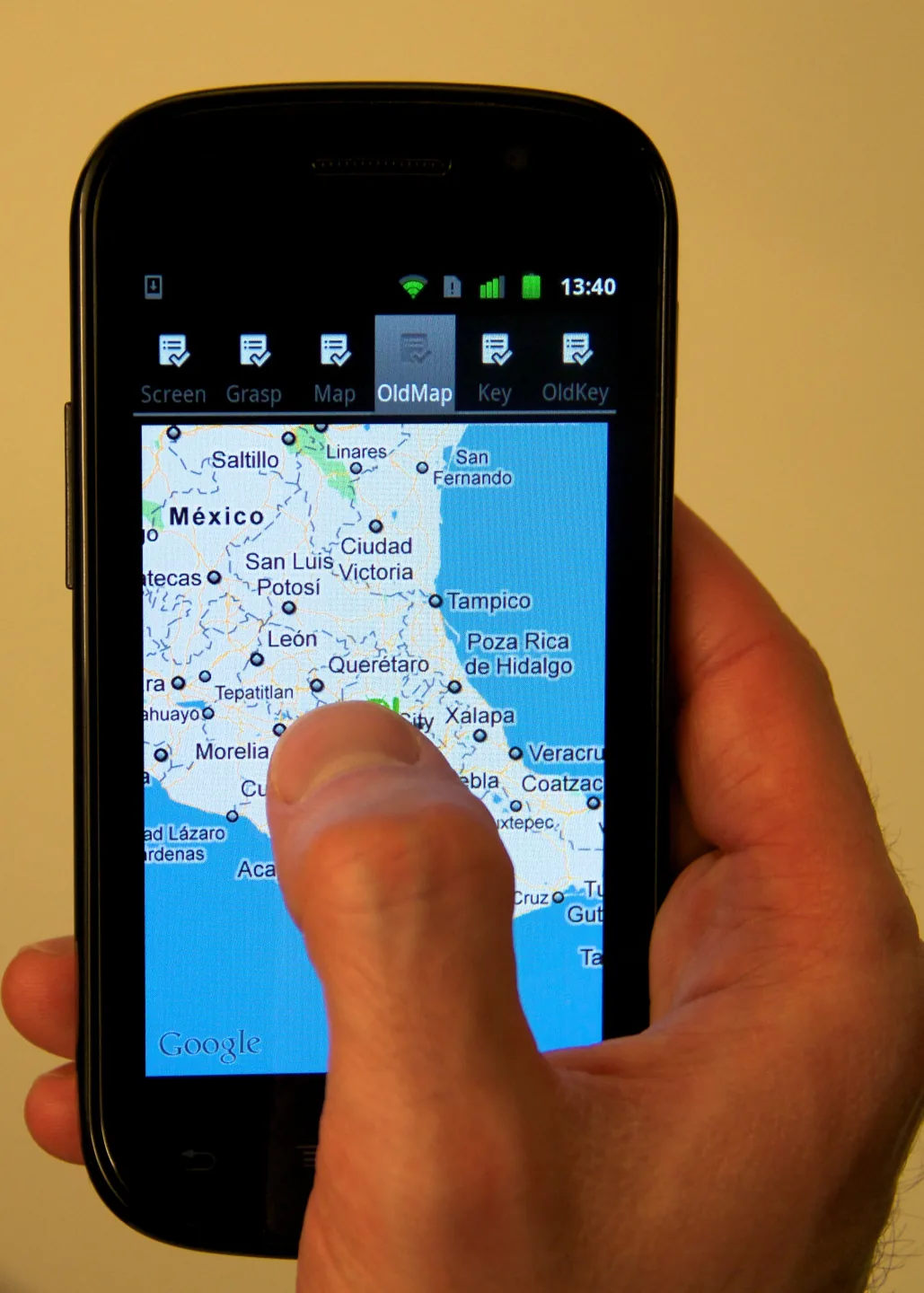
[GripSense (research prototype)](https://ubicomplab.cs.washington.edu/pdfs/gripsense.pdf) · © The authors / ACM, UIST 2012. Photograph extracted from Figure 1 on PDF page 1. Research prototype; separate rights retained. Excluded from MIT and CC BY 4.0.
1. The prototype estimates pressure from indirect vibration measurements
- Validate the specific hardware model, grip and measurement conditions.
- [GripSense (research prototype)](https://ubicomplab.cs.washington.edu/pdfs/gripsense.pdf)
## How it works
These ideas require separate prototype, calibration, or equipment. These are not standard features of any phone.
## Variants
### Variants and applications
- Estimation of pressure by attenuation. Role: Experiment. Features: Separate prototype. Enter: sensors. Rule: The motor excites vibrations, and the sensors measure the change in response when pressed; the algorithm estimates the conditional pressure level. Application: Research input, additional control axis. Limitations: Principle studied in GripSense; This is an indirect assessment on specific equipment, not a universal force sensor.
- Surface recognition. Role: Experiment. Features: Separate prototype. Enter: sensors. Rule: Known motor excitation is matched with measured response and trained surface samples. Application: Prototype for detecting where a phone is lying, contextual interface. Limitations: VibePhone explores this approach; we need training data and testing of a specific set of surfaces.
- Exchange through a common surface. Role: Experiment. Features: Separate prototype. Input: sensors, second phone. Rule: One phone encodes a message in pulses, the other tries to decode surface vibrations with an accelerometer. Application: Research communication, desktop interactive object. Limitations: VibeComm shows the principle; the channel is slow and depends on the surface and calibration, does not replace the default network.
- On the left and right there are two phones. Role: Experiment. Features: Separate prototype. Input: two devices, network. Rule: Two independently controlled devices provide separate signals, allowing side to be encoded by bodily location. Application: Spatial guidance experiment, paired interactive scene. Limitations: Requires two actuators at different locations and synchronization; One regular phone does not guarantee such a channel.
- Phone and wearable actuator. Role: Experiment. Features: Separate prototype. Input: BLE, accessory. Rule: The phone calculates the event, and the bracelet or other compatible accessory plays the signal at the specified location. Application: Training, accessible navigation, immersive gaming. Limitations: Requires accessory protocol, permissions and latency testing; This is a separate piece of equipment...
- Local screen vibration. Role: Experiment. Features: Separate prototype. Input: special display. Rule: An array of actuators or a special design creates spatially distinct regions of response. Application: Research panel, tactile map, multiple independent contacts. Limitations: The standard phone API does not create random vibration under each finger.
- Controlled surface friction. Role: Experiment. Features: Separate prototype. Input: special display. Rule: A special electrostatic or ultrasonic system changes the feeling of finger sliding. Applications: Texture exploration, tactile boundaries, material interfaces. Limitations: Requires appropriate surface and control electronics; A regular vibration motor is not enough...
- Physical resistance to movement. Role: Experiment. Features: Separate prototype. Input: mechanical accessory. Rule: An external mechanism creates force or emphasis, and the phone controls the scenario and complements it with vibration. Application: Trainer, manipulator, tool simulator. Limitations: Resistance is created by an accessory; The vibration of the phone itself does not hold the finger or hand.
- Movement on a vibration stand. Role: Experiment. Features: Separate prototype. Input: stand, sensors. Rule: Concept: an asymmetrical support converts body vibrations into movement of a physical structure. Application: Robotics experiment, physical toy. Limitations: The bristlebot principle is known, but performance with a whole specific phone is not established by this catalog.
- The surface is like a resonator. Role: Experiment. Features: Separate prototype. Input: stand, microphone. Rule: Concept: Motor pulses excite the table or body of an object, changing the audible and felt response. Applications: Interactive installation, acoustics research, material interface. Limitations: Effect depends on contact and material; controlled sound and the same sensation for participants are not guaranteed.
## Context and limits
Author's systematization: 160 cards in 16 groups. These are mechanics, feedback techniques, applications and experimental extensions, not 160 independent physical effects. Design examples are hypothetical, not statements about the released games that used them.
## Connected materials
## Sources and provenance
Original editorial design catalog consolidated from project discussions on 2026-10-20. Complete discussion item lists and contextual limitations are preserved; linked primary sources support specific techniques, not the entire classification. English translation was prepared with machine assistance and editorial review.
- [GripSense, UIST 2012](https://ubicomplab.cs.washington.edu/pdfs/gripsense.pdf) (id: source-2d119312b0d0b494)
- [VibePhone: Vibration-Based Surface Recognition, 2012](https://rllab.snu.ac.kr/publications/papers/2012_cpsna_vibephone.pdf) (id: source-62e3bac1dde44c25)
- [VibeComm, Sensors 2014](https://www.mdpi.com/1424-8220/14/11/21151) (id: source-798a2aacc8656d8f)
- [Bristlebot: theoretical analysis, 2014](https://arxiv.org/abs/1410.8153) (id: source-6175162035ea5ec9)
- [Localized haptics: PVDF actuators, 2023](https://www.mdpi.com/2076-0825/12/7/289) (id: source-32c2d8d34a7ae8a5)
- [Disney Research: TeslaTouch, 2010](https://la.disneyresearch.com/publication/teslatouch-electrovibration-for-touch-surfaces/) (id: source-da3f53b0f458f983)
- [Microsoft Research: TouchMover, 2013](https://www.microsoft.com/en-us/research/publication/touchmover-actuated-3d-touchscreen-with-haptic-feedback/) (id: source-ef6817a54d2a7235)
CC-BY-4.0 · gamemechanics.pro contributors