---
key: mechanic/phone-flashlight--family-camera
type: mechanic
id: phone-flashlight--family-camera
lang: en
title: 'Search, camera and augmented reality'
summary: >-
The camera observes a scene lit by the phone LED. WildLight uses these images
for reconstruction; flash and autoexposure affect the result.
updatedAt: '2026-10-22'
status: active
url: >-
https://gamemechanics.pro/en/knowledge/mechanic/phone-flashlight--family-camera/
jsonUrl: >-
https://gamemechanics.pro/api/v1/knowledge/en/mechanic/phone-flashlight--family-camera.json
markdownUrl: >-
https://gamemechanics.pro/content/knowledge/en/mechanic/phone-flashlight--family-camera.md
aliases: []
tags:
- Phone flashlight interactions
- Mechanics catalog
sourceIds:
- source-486438ca6bfacdc6
sources:
- id: source-486438ca6bfacdc6
title: WildLight (research prototype)
url: 'https://junxuan-li.github.io/wildlight-website/'
verifiedAt: null
relations: []
placements:
- catalogId: phone-flashlight
id: family-camera
title: Phone flashlight interactions
url: 'https://gamemechanics.pro/en/mechanics/phone-flashlight/#family-camera'
categoryIds:
- section-1
supersededBy: []
attributes:
preview:
updatedAt: '2026-10-22'
title: 'Search, camera and augmented reality'
description: >-
The camera observes a scene lit by the phone LED. WildLight uses these
images for reconstruction; flash and autoexposure affect the result.
image:
src: images/mechanics/flash-wildlight.webp
width: 1440
height: 387
crop:
x: 0
'y': 0
width: 568
height: 266
game: WildLight (research prototype)
sourceUrl: 'https://junxuan-li.github.io/wildlight-website/'
originalUrl: 'https://junxuan-li.github.io/wildlight-website/static/images/teaser.jpg'
credit: 'Ziang Cheng, Junxuan Li, Hongdong Li'
rights: >-
© Ziang Cheng, Junxuan Li, Hongdong Li. Author-distributed research
figure; respective rights retained. Excluded from portal MIT and CC BY
4.0.
caption: 'WildLight: input images without and with the flashlight'
alt: 'WildLight: input images without and with the flashlight'
markers:
- x: 29
'y': 24
label: The right input image was captured with the flashlight on
tips:
- >-
Synchronize capture with the LED; nearby reflections can obscure the
target.
examples:
- title: WildLight (research prototype)
url: 'https://junxuan-li.github.io/wildlight-website/'
endsAt: null
provenance: >-
Original editorial design catalog consolidated from project discussions on
2026-10-20. Complete discussion item lists and contextual limitations are
preserved; linked primary sources support specific techniques, not the entire
classification. English translation was prepared with machine assistance and
editorial review.
license: CC-BY-4.0
codeLicense: MIT
attribution: gamemechanics.pro contributors
catalogKey: catalog/phone-flashlight
---
# Search, camera and augmented reality
id: phone-flashlight--family-camera
type: mechanic
key: mechanic/phone-flashlight--family-camera
lang: en
status: active
url: https://gamemechanics.pro/en/knowledge/mechanic/phone-flashlight--family-camera/
The camera observes a scene lit by the phone LED. WildLight uses these images for reconstruction; flash and autoexposure affect the result.
## At a glance
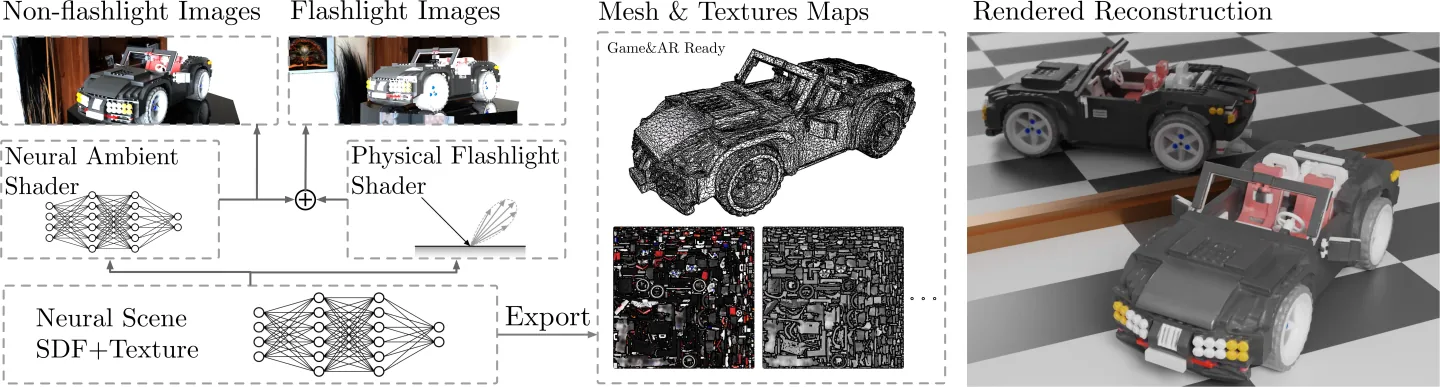
[WildLight (research prototype)](https://junxuan-li.github.io/wildlight-website/) · © Ziang Cheng, Junxuan Li, Hongdong Li. Author-distributed research figure; respective rights retained. Excluded from portal MIT and CC BY 4.0.
1. The right input image was captured with the flashlight on
- Synchronize capture with the LED; nearby reflections can obscure the target.
- [WildLight (research prototype)](https://junxuan-li.github.io/wildlight-website/)
## How it works
The camera observes the scene; a flashlight helps illuminate it or becomes part of the rule.
## Variants
### Variants and applications
- Illuminated mark. Action: Find and recognize a printed mark when the light is on. Application: Opening content for an item, home quest, museum card. Requirements: Rear LED and control from the application; Camera and proprietary image analysis. Conditions: The tag is read by the camera; Turning on the light does not in itself prove that the beam hit.
- Inspection of an object by recognition. Action: Point the camera at the prepared class of objects. Application: Collection catalog, educational object hunt, game inventory. Requirements: Rear LED and control from the application; Camera and proprietary image analysis. Conditions: Recognition and testing on target objects are required; The flashlight does not recognize materials.
- Comparison “lights off/on.” Action: Compare two frames of an almost motionless scene. Application: Find a changed area, evaluate the contribution of the backlight, experiment. Requirements: Rear LED and control from the application; Camera and proprietary image analysis. Conditions: Autoexposure and motion distort the difference; need stabilization and control of parameters.
- Search by reflection. Action: Use the camera to notice the light response of the prepared object. Application: Find a reflective mark among ordinary ones, localize the target. Requirements: Rear LED and control from the application; Camera and proprietary image analysis; Prepared props or external sensor. Conditions: The algorithm distinguishes the prepared response, and not any valuable or metal object.
- Stacked sight. Action: Hold the recognized object in the frame when the LED is on. Application: “Scan” evidence, register a find, read a game sample. Requirements: Rear LED and control from the application; Camera and proprietary image analysis; Software game rule. Conditions: Accumulation is the rule of the game; the real content of an object is not measured this way.
- Traces visible only in the application. Action: Show virtual markers when the flashlight is active and the camera is pointed at the area. Application: AR detective, ghost hunting, hidden inscriptions. Requirements: Rear LED and app control; Camera and spatial tracking; Software game rule. Conditions: Traces are drawn by the application; white LED does not show random invisible ink.
- Map of surveyed areas. Action: Mark areas where the player pointed the camera with the flashlight on. Application: Search for missed points, explore a virtual room. Requirements: Rear LED and control from the application; Camera and spatial tracking; Software game rule. Conditions: Tracking evaluates the view and does not guarantee actual coverage of each area.
- Photo as confirmation. Action: After illumination, take a shot with the desired object or composition. Application: Photo hunt, proof of completion of a quest, collection of finds. Requirements: Rear LED and control from the application; Camera and proprietary image analysis. Conditions: You need a way to check the frame: person, tag or recognition; Photo storage is not necessary.
- Glowing beacon in the frame. Action: Observe the LED as a conspicuous point with another camera. Application: Simple light guidance, prop tracking, signal laboratory. Requirements: Rear LED and app control; Camera and proprietary image analysis; Multiple devices/participants; sometimes an observer is enough. Conditions: One point provides limited data; flare, overlap and background interfere with tracking.
- Several angles under different light. Action: Shoot a stationary object while moving the source. Application: Texture research, art documentation, relief restoration prototype. Requirements: Rear LED and control from the application; Camera and proprietary image analysis; Prepared props or external sensor; Multiple devices/participants; sometimes an observer is enough. Conditions: Accurate shape restoration requires calibration and algorithm; telephone light not ready 3D scanner.
## Context and limits
Author's working classification for designing games and interactions. Options can overlap and combine; the list is not a generally accepted standard or proven exhaustive list. Application examples are conditional unless a specific verifiable observation is indicated nearby. Sources support individual techniques and technical limitations.
## Connected materials
## Sources and provenance
Original editorial design catalog consolidated from project discussions on 2026-10-20. Complete discussion item lists and contextual limitations are preserved; linked primary sources support specific techniques, not the entire classification. English translation was prepared with machine assistance and editorial review.
- [WildLight (research prototype)](https://junxuan-li.github.io/wildlight-website/) (id: source-486438ca6bfacdc6)
CC-BY-4.0 · gamemechanics.pro contributors