---
key: mechanic/movement-platforming--t006
type: mechanic
id: movement-platforming--t006
lang: en
title: Climbing and holding onto surfaces
summary: >-
The player uses a suitable surface for hand and foot support. Grabs, climb
boundaries and transitions determine the available route.
updatedAt: '2026-10-21'
status: active
url: 'https://gamemechanics.pro/en/knowledge/mechanic/movement-platforming--t006/'
jsonUrl: >-
https://gamemechanics.pro/api/v1/knowledge/en/mechanic/movement-platforming--t006.json
markdownUrl: >-
https://gamemechanics.pro/content/knowledge/en/mechanic/movement-platforming--t006.md
aliases:
- Climbing surfaces
tags:
- Movement and platforming
- Mechanics and variants
sourceIds:
- source-b8626268f7974a44
- source-ad5935e19b434514
- source-8b181715b5c89953
- source-a05c1a03957ea296
sources:
- id: source-b8626268f7974a44
title: 'Godot: 2D movement overview'
url: 'https://docs.godotengine.org/en/stable/tutorials/2d/2d_movement.html'
verifiedAt: null
- id: source-ad5935e19b434514
title: 'Maddy Thorson: Celeste & TowerFall Physics'
url: >-
https://www.mattmakesgames.com/articles/celeste_and_towerfall_physics/index.html
verifiedAt: null
- id: source-8b181715b5c89953
title: 'Godot: CharacterBody3D'
url: 'https://docs.godotengine.org/en/stable/classes/class_characterbody3d.html'
verifiedAt: null
- id: source-a05c1a03957ea296
title: Tom Clancy's Splinter Cell (2002)
url: 'https://gamemechanics.org/patterns/climbing-over-fences'
verifiedAt: null
relations: []
placements:
- catalogId: movement-platforming
id: t006
title: Movement and platforming
url: 'https://gamemechanics.pro/en/mechanics/movement-platforming/#t006'
categoryIds:
- mechanics
supersededBy: []
attributes:
preview:
updatedAt: '2026-10-21'
title: Climbing surfaces
description: >-
The player uses a suitable surface for hand and foot support. Grabs, climb
boundaries and transitions determine the available route.
image:
src: images/mechanics/splinter-cell-fence.webp
width: 600
height: 328
game: Tom Clancy's Splinter Cell (2002)
sourceUrl: 'https://gamemechanics.org/patterns/climbing-over-fences'
originalUrl: 'https://cdn.gamemechanics.org/webm/splinter_cell_climb_fence.webm'
sourceFrameSeconds: 4.5
credit: Ubisoft Montréal; clip via GameMechanics.org
rights: >-
© respective game rights holders. Clip source: GameMechanics.org. All
rights reserved.
caption: A chain-link surface as support
alt: >-
Tom Clancy's Splinter Cell (2002): Sam holds a chain-link fence while
crossing its top edge.
markers:
- x: 45
'y': 53
label: Hands and feet use the surface for support
tips:
- Distinguish climbable surfaces from decoration.
- 'Check transitions to edges, ground and adjacent supports.'
examples:
- title: Tom Clancy's Splinter Cell (2002)
url: 'https://gamemechanics.org/patterns/climbing-over-fences'
endsAt: null
provenance: >-
Original bilingual editorial overviews authored for gamemechanics.pro on
2026-10-20 and reviewed on 2026-10-21. Scenarios are hypothetical design
examples; prototype checks describe work to perform, not completed playtests.
Primary sources support the stated techniques and implementation context, not
every proposed variant.
license: CC-BY-4.0
codeLicense: MIT
attribution: gamemechanics.pro contributors
catalogKey: catalog/movement-platforming
---
# Climbing and holding onto surfaces
id: movement-platforming--t006
type: mechanic
key: mechanic/movement-platforming--t006
lang: en
status: active
url: https://gamemechanics.pro/en/knowledge/mechanic/movement-platforming--t006/
The player uses a suitable surface for hand and foot support. Grabs, climb boundaries and transitions determine the available route.
## At a glance
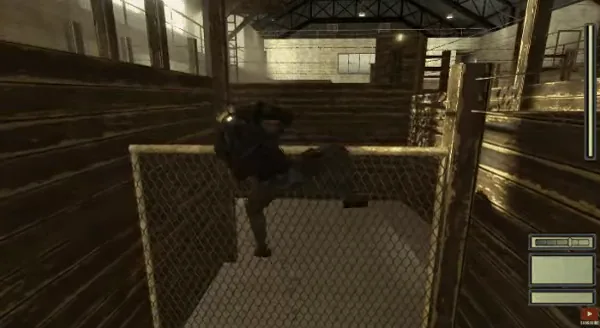
[Tom Clancy's Splinter Cell (2002)](https://gamemechanics.org/patterns/climbing-over-fences) · © respective game rights holders. Clip source: GameMechanics.org. All rights reserved.
[Source recording](https://cdn.gamemechanics.org/webm/splinter_cell_climb_fence.webm), 4.5 s
1. Hands and feet use the surface for support
- Distinguish climbable surfaces from decoration.
- Check transitions to edges, ground and adjacent supports.
- [Tom Clancy's Splinter Cell (2002)](https://gamemechanics.org/patterns/climbing-over-fences)
## How it works
The player selects a sequence of handholds and manages grip capacity to change height without safe ground below.
## Variants
### Mechanic variants
- Explicit handholds: movement connects marked points within reach.
- Climbable surfaces: material, slope or traction determines access.
- Grip reserves: exertion limits long climbs and makes rest positions valuable.
- Slip recovery: a failing grip can be rescued by catching a lower hold.
## Design example
A cliff offers a short overhanging route and a longer path through a recovery ledge.
Prototype check: Disable exertion and compare routes: the constraint should change choices while leaving at least one viable path.
## Context and limits
Movement connects input, trajectory and accessible space. Players assess support, speed and remaining abilities, choose an action and correct their motion through feedback. These ten directions range from flat platforming to underwater movement. A first prototype needs only a few surfaces and one distinctive rule; the camera, collisions and return of control should explain success or failure. Godot documentation provides implementation examples, while the Celeste and TowerFall author describes one approach to movement and platforms; these choices are not mandatory in every engine.
## Connected materials
## Sources and provenance
Original bilingual editorial overviews authored for gamemechanics.pro on 2026-10-20 and reviewed on 2026-10-21. Scenarios are hypothetical design examples; prototype checks describe work to perform, not completed playtests. Primary sources support the stated techniques and implementation context, not every proposed variant.
- [Godot: 2D movement overview](https://docs.godotengine.org/en/stable/tutorials/2d/2d_movement.html) (id: source-b8626268f7974a44)
- [Maddy Thorson: Celeste & TowerFall Physics](https://www.mattmakesgames.com/articles/celeste_and_towerfall_physics/index.html) (id: source-ad5935e19b434514)
- [Godot: CharacterBody3D](https://docs.godotengine.org/en/stable/classes/class_characterbody3d.html) (id: source-8b181715b5c89953)
- [Tom Clancy's Splinter Cell (2002)](https://gamemechanics.org/patterns/climbing-over-fences) (id: source-a05c1a03957ea296)
CC-BY-4.0 · gamemechanics.pro contributors