---
key: mechanic/mouse--family-precision
type: mechanic
id: mouse--family-precision
lang: en
title: Precision and spatial challenges
summary: >-
The player aligns the pointer with a target or acts within defined boundaries.
Target size and sensitivity affect difficulty.
updatedAt: '2026-10-22'
status: active
url: 'https://gamemechanics.pro/en/knowledge/mechanic/mouse--family-precision/'
jsonUrl: >-
https://gamemechanics.pro/api/v1/knowledge/en/mechanic/mouse--family-precision.json
markdownUrl: >-
https://gamemechanics.pro/content/knowledge/en/mechanic/mouse--family-precision.md
aliases:
- Pointing precision
tags:
- Mouse interactions
- Applied Mechanics
sourceIds:
- source-872a30e434db6d16
sources:
- id: source-872a30e434db6d16
title: Duolingo
url: >-
https://blog.duolingo.com/duolingo-101-how-to-learn-a-language-on-duolingo/
verifiedAt: null
relations: []
placements:
- catalogId: mouse
id: family-precision
title: Mouse interactions
url: 'https://gamemechanics.pro/en/mechanics/mouse/#family-precision'
categoryIds:
- section-2
supersededBy: []
attributes:
preview:
updatedAt: '2026-10-22'
title: Pointing precision
description: >-
The player aligns the pointer with a target or acts within defined
boundaries. Target size and sensitivity affect difficulty.
image:
src: images/mechanics/learning-duo-101-12.webp
width: 665
height: 1440
game: Duolingo
sourceUrl: >-
https://blog.duolingo.com/duolingo-101-how-to-learn-a-language-on-duolingo/
originalUrl: >-
https://s3.us-east-1.amazonaws.com/content.duolingo.com/Duolingo+101%3A+How+to+learn+a+language+on+Duolingo/14-characterBingo.png
credit: Duolingo
rights: © Duolingo. All rights reserved. Excluded from MIT and CC BY 4.0.
caption: 'Duolingo: a guide for the missing stroke'
alt: 'Duolingo: a guide for the missing stroke'
markers:
- x: 48
'y': 45
label: The arrow shows the stroke direction
tips:
- Avoid targets too small to distinguish.
examples:
- title: Duolingo
url: >-
https://blog.duolingo.com/duolingo-101-how-to-learn-a-language-on-duolingo/
endsAt: null
provenance: >-
Original editorial design catalog consolidated from project discussions on
2026-10-20. Complete discussion item lists and contextual limitations are
preserved; linked primary sources support specific techniques, not the entire
classification. English translation was prepared with machine assistance and
editorial review.
license: CC-BY-4.0
codeLicense: MIT
attribution: gamemechanics.pro contributors
catalogKey: catalog/mouse
---
# Precision and spatial challenges
id: mouse--family-precision
type: mechanic
key: mechanic/mouse--family-precision
lang: en
status: active
url: https://gamemechanics.pro/en/knowledge/mechanic/mouse--family-precision/
The player aligns the pointer with a target or acts within defined boundaries. Target size and sensitivity affect difficulty.
## At a glance
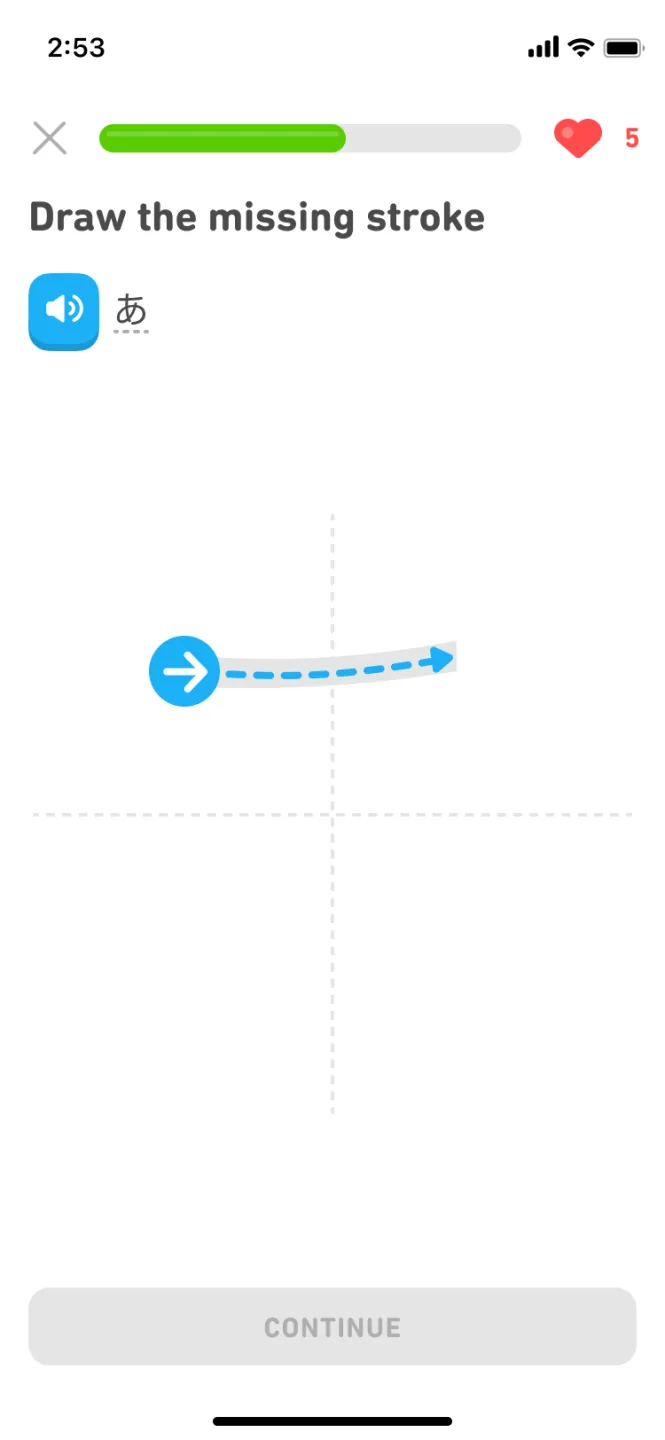
[Duolingo](https://blog.duolingo.com/duolingo-101-how-to-learn-a-language-on-duolingo/) · © Duolingo. All rights reserved. Excluded from MIT and CC BY 4.0.
1. The arrow shows the stroke direction
- Avoid targets too small to distinguish.
- [Duolingo](https://blog.duolingo.com/duolingo-101-how-to-learn-a-language-on-duolingo/)
## How it works
Difficulty is determined by the location of targets, acceptable areas, speed and stability of movement.
## Variants
### Variants and applications
- Hitting a small target. Action: Accurately point and give a command. Application: Accuracy test, microsurgery, small switches. Conditions: The size of the target must correspond to the task and capabilities of the audience.
- Transition between goals. Action: Move the cursor over a given set of points. Application: Targeting training, operator work, sequential activation of nodes. Conditions: Distance and target size change the difficulty independently.
- Tracking a moving target. Action: Continuously hold the pointer on the target. Application: Scanning an object, tracking, aiming, research. Conditions: Set target speed and contact duration separately.
- Keeping in a safe zone. Action: Stay inside the area for a limited time. Application: Tool stabilization, balancing, neutralization. Conditions: Show margin to the border and accumulated progress.
- Passage of the corridor. Action: Move the pointer from the entrance to the exit without touching the walls. Application: Labyrinth with a cursor, guiding a tool, precision operation. Conditions: Check the segments of movement between events so as not to miss the walls.
- Dodging with the cursor. Action: Avoid moving dangerous areas. Application: Arcade with character cursor, protect the tool from interference. Conditions: Designate the size of the game cursor collision area.
- Sequential crossing of gates. Action: Pass control zones in a given order. Application: Route, air gates, signal wiring. Conditions: The system must show the following mandatory zone.
- Maintaining direction. Action: Move the pointer in the permitted direction relative to a line or surface. Application: Proper grinding, combing, one-sided cutting. Conditions: Show direction and angle tolerance.
- Maintain speed. Action: Move the mouse within the specified speed range. Application: Welding, painting, carrying a fragile object, guiding a tool. Conditions: Calculate speed based on time; consider sensitivity and scale.
- Stabilization with disturbances. Action: Compensate for software drift or cursor wobble. Application: Balance, beam hold, aiming in cluttered conditions. Conditions: Separate visual disturbance from actual mouse settings.
## Context and limits
Author's working classification for designing games and interactions. Options can overlap and combine; the list is not a generally accepted standard or proven exhaustive list. Application examples are conditional unless a specific verifiable observation is indicated nearby. Sources support individual techniques and technical limitations.
## Connected materials
## Sources and provenance
Original editorial design catalog consolidated from project discussions on 2026-10-20. Complete discussion item lists and contextual limitations are preserved; linked primary sources support specific techniques, not the entire classification. English translation was prepared with machine assistance and editorial review.
- [Duolingo](https://blog.duolingo.com/duolingo-101-how-to-learn-a-language-on-duolingo/) (id: source-872a30e434db6d16)
CC-BY-4.0 · gamemechanics.pro contributors