---
key: mechanic/keyboard--family-coordination
type: mechanic
id: keyboard--family-coordination
lang: en
title: Hand-finger coordination
summary: >-
Different keys independently control parts of a system. QWOP maps Q/W and O/P
to thighs and calves, requiring the player to coordinate movement.
updatedAt: '2026-10-22'
status: active
url: 'https://gamemechanics.pro/en/knowledge/mechanic/keyboard--family-coordination/'
jsonUrl: >-
https://gamemechanics.pro/api/v1/knowledge/en/mechanic/keyboard--family-coordination.json
markdownUrl: >-
https://gamemechanics.pro/content/knowledge/en/mechanic/keyboard--family-coordination.md
aliases: []
tags:
- Physical keyboard interactions
- Physical constraints
sourceIds:
- source-a19769eb973e41a1
sources:
- id: source-a19769eb973e41a1
title: QWOP
url: 'https://www.foddy.net/legacy/Athletics.html'
verifiedAt: null
relations: []
placements:
- catalogId: keyboard
id: family-coordination
title: Physical keyboard interactions
url: 'https://gamemechanics.pro/en/mechanics/keyboard/#family-coordination'
categoryIds:
- section-4
supersededBy: []
attributes:
preview:
updatedAt: '2026-10-22'
title: Hand-finger coordination
description: >-
Different keys independently control parts of a system. QWOP maps Q/W and
O/P to thighs and calves, requiring the player to coordinate movement.
image:
src: images/mechanics/control-qwop.webp
width: 1280
height: 720
crop:
x: 320
'y': 82
width: 640
height: 384
game: QWOP
sourceUrl: 'https://www.foddy.net/legacy/Athletics.html'
originalUrl: 'https://www.foddy.net/legacy/Athletics.html'
credit: Bennett Foddy
rights: >-
Imagery © Bennett Foddy. Developer-distributed screenshot or frame; all
rights reserved. Excluded from MIT and CC BY 4.0.
caption: 'QWOP: separate keys control thighs and calves'
alt: 'QWOP: separate keys control thighs and calves'
markers:
- x: 70
'y': 18
label: O and P control calves; Q and W control thighs
tips:
- A key press does not prove which finger produced it.
examples:
- title: QWOP
url: 'https://www.foddy.net/legacy/Athletics.html'
endsAt: null
provenance: >-
Original editorial design catalog consolidated from project discussions on
2026-10-20. Complete discussion item lists and contextual limitations are
preserved; linked primary sources support specific techniques, not the entire
classification. English translation was prepared with machine assistance and
editorial review.
license: CC-BY-4.0
codeLicense: MIT
attribution: gamemechanics.pro contributors
catalogKey: catalog/keyboard
---
# Hand-finger coordination
id: keyboard--family-coordination
type: mechanic
key: mechanic/keyboard--family-coordination
lang: en
status: active
url: https://gamemechanics.pro/en/knowledge/mechanic/keyboard--family-coordination/
Different keys independently control parts of a system. QWOP maps Q/W and O/P to thighs and calves, requiring the player to coordinate movement.
## At a glance
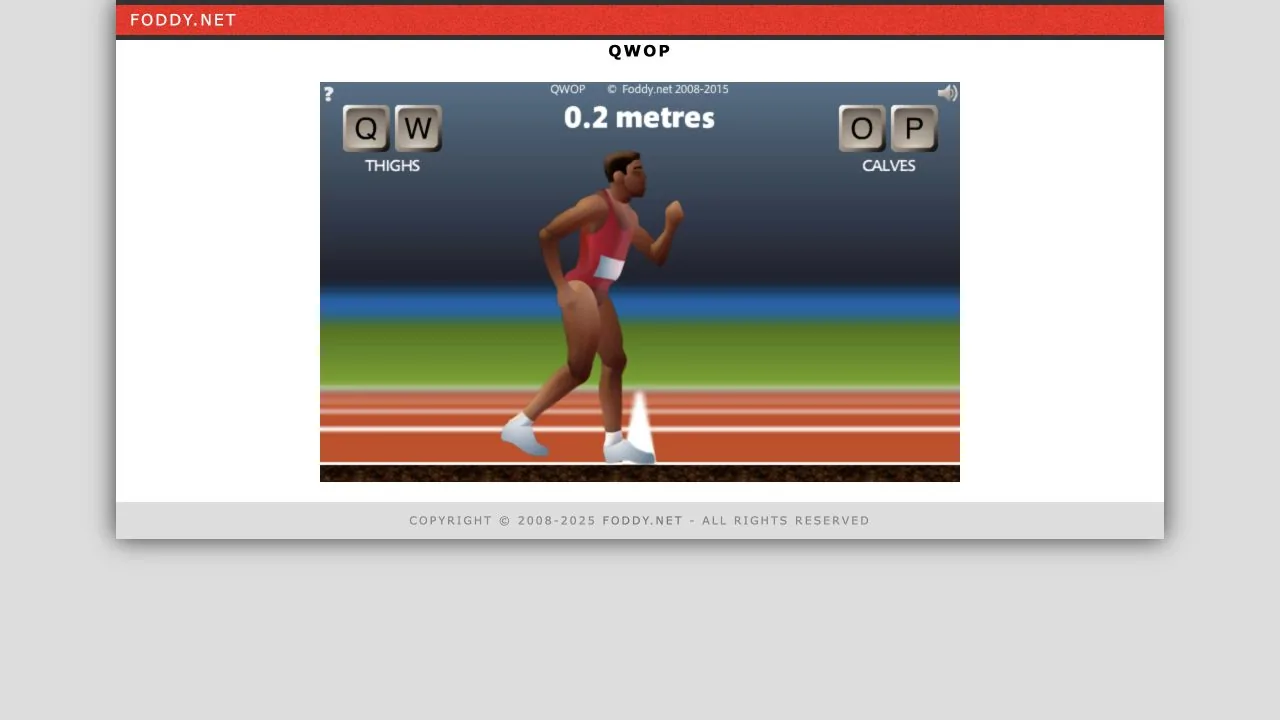
[QWOP](https://www.foddy.net/legacy/Athletics.html) · Imagery © Bennett Foddy. Developer-distributed screenshot or frame; all rights reserved. Excluded from MIT and CC BY 4.0.
1. O and P control calves; Q and W control thighs
- A key press does not prove which finger produced it.
- [QWOP](https://www.foddy.net/legacy/Athletics.html)
## How it works
You can check zone events, but a regular keyboard does not detect your hand or finger.
## Variants
### Variants and applications
- Independent parties of two hands. Action: Each zone receives its own flow of actions. Application: Two characters by one player, melody and accompaniment, two working instruments. Conditions: Zones are checked by software; The distribution of hands remains an agreement. Equipment: Regular keyboard.
- Mirror movements. Action: Paired keys on the left and right are pressed symmetrically. Application: Synchronized wings, balancing of two supports, coordination trainer. Conditions: Symmetry is set by the selected key map. Equipment: Regular keyboard.
- Antiphase movements. Action: Paired zones alternate activity: one is pressed, the other is released. Application: Steps, pedals, swings, two-piston mechanism. Conditions: The state of the keys is checked, not the position of the limbs. Equipment: Regular keyboard.
- Maintaining support and working nearby. Action: One key remains pressed, the others perform additional actions. Application: Climber, manual repair, multi-point play. Conditions: Check the ease of reach and the number of keys held. Equipment: Regular keyboard.
- Fingers are like limbs. Action: Several assigned keys control different parts of the body or manipulator. Application: Walking robot, puppet, multi-fingered gripper. Conditions: Use of a specific finger without an external sensor is not tested. Equipment: Regular keyboard.
- Transfer between zones. Action: Actions require switching between remote areas of the keyboard. Application: Multi-panel manager, emergency change of working tools. Conditions: Hand transfer time is part of the complexity of the task. Equipment: Regular keyboard.
- Crossing hands. Action: Rule asks for hands to be swapped while maintaining key bindings. Application: Local cooperation, stage act, body puzzle. Conditions: Compliance requires an observer, camera or trust. Equipment: Physical condition.
- Work without visual control. Action: Find keys by touch and act from memory. Application: Teaching touch typing, audio game, task with the keyboard hidden from view. Conditions: Gaze cannot be determined by keyboard events. Equipment: Physical condition.
## Context and limits
Author's working classification for designing games and interactions. Options can overlap and combine; the list is not a generally accepted standard or proven exhaustive list. Application examples are conditional unless a specific verifiable observation is indicated nearby. Sources support individual techniques and technical limitations.
## Connected materials
## Sources and provenance
Original editorial design catalog consolidated from project discussions on 2026-10-20. Complete discussion item lists and contextual limitations are preserved; linked primary sources support specific techniques, not the entire classification. English translation was prepared with machine assistance and editorial review.
- [QWOP](https://www.foddy.net/legacy/Athletics.html) (id: source-a19769eb973e41a1)
CC-BY-4.0 · gamemechanics.pro contributors