---
key: mechanic/goals-feedback--t278
type: mechanic
id: goals-feedback--t278
lang: en
title: 'Inventories, maps and interfaces as play spaces'
summary: >-
Interfaces become play spaces when placing, connecting or interpreting their
elements directly changes a challenge's solution.
updatedAt: '2026-10-22'
status: active
url: 'https://gamemechanics.pro/en/knowledge/mechanic/goals-feedback--t278/'
jsonUrl: >-
https://gamemechanics.pro/api/v1/knowledge/en/mechanic/goals-feedback--t278.json
markdownUrl: >-
https://gamemechanics.pro/content/knowledge/en/mechanic/goals-feedback--t278.md
aliases:
- Interface as a play space
tags:
- 'Goals, difficulty, learning and feedback'
- Mechanics and variants
sourceIds:
- source-d4c7409816f79db5
- source-6669156765be17e4
sources:
- id: source-d4c7409816f79db5
title: Game Accessibility Guidelines
url: 'https://gameaccessibilityguidelines.com/'
verifiedAt: null
- id: source-6669156765be17e4
title: Resident Evil 4 (2023)
url: 'https://gamemechanics.org/patterns/tetris-inventory'
verifiedAt: null
relations: []
placements:
- catalogId: goals-feedback
id: t278
title: 'Goals, difficulty, learning and feedback'
url: 'https://gamemechanics.pro/en/mechanics/goals-feedback/#t278'
categoryIds:
- mechanics
supersededBy: []
attributes:
preview:
updatedAt: '2026-10-22'
title: Interface as a play space
description: >-
Interfaces become play spaces when placing, connecting or interpreting
their elements directly changes a challenge's solution.
image:
src: images/mechanics/combat-tetris-inventory.webp
width: 1024
height: 576
crop:
x: 245
'y': 68
width: 515
height: 370
game: Resident Evil 4 (2023)
sourceUrl: 'https://gamemechanics.org/patterns/tetris-inventory'
originalUrl: 'https://cdn.gamemechanics.org/resident_evil_4_remake_inventory.jpg'
credit: Capcom; image via GameMechanics.org
rights: >-
Game imagery © its respective rights holders. Source host:
GameMechanics.org. All rights reserved; excluded from the portal’s MIT
and CC BY 4.0 licenses.
caption: Items occupy cells in the case grid
alt: Items occupy cells in the case grid
markers:
- x: 49
'y': 45
label: An item’s shape affects packing
- x: 70
'y': 62
label: Free cells constrain the next placement
tips:
- Show placement constraints before an action is confirmed.
examples:
- title: Resident Evil 4 (2023)
url: 'https://gamemechanics.org/patterns/tetris-inventory'
endsAt: null
provenance: >-
Original bilingual editorial overviews authored for gamemechanics.pro on
2026-10-20 and reviewed on 2026-10-21. Scenarios are hypothetical design
examples; prototype checks describe work to perform, not completed playtests.
Primary sources support the stated techniques and implementation context, not
every proposed variant.
license: CC-BY-4.0
codeLicense: MIT
attribution: gamemechanics.pro contributors
catalogKey: catalog/goals-feedback
---
# Inventories, maps and interfaces as play spaces
id: goals-feedback--t278
type: mechanic
key: mechanic/goals-feedback--t278
lang: en
status: active
url: https://gamemechanics.pro/en/knowledge/mechanic/goals-feedback--t278/
Interfaces become play spaces when placing, connecting or interpreting their elements directly changes a challenge's solution.
## At a glance
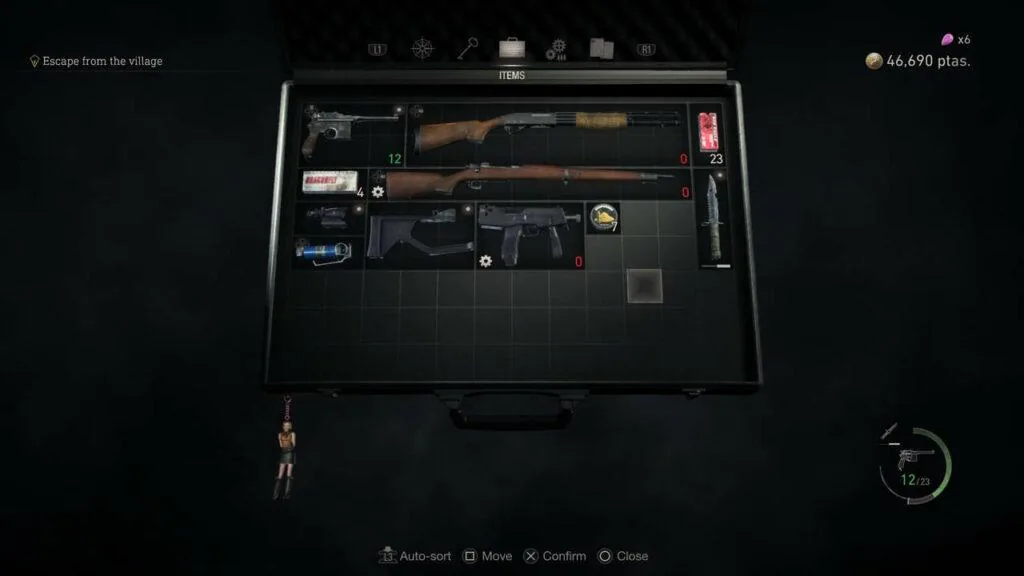
[Resident Evil 4 (2023)](https://gamemechanics.org/patterns/tetris-inventory) · Game imagery © its respective rights holders. Source host: GameMechanics.org. All rights reserved; excluded from the portal’s MIT and CC BY 4.0 licenses.
1. An item’s shape affects packing
2. Free cells constrain the next placement
- Show placement constraints before an action is confirmed.
- [Resident Evil 4 (2023)](https://gamemechanics.org/patterns/tetris-inventory)
## How it works
Interfaces become play spaces when placing, connecting or interpreting their elements directly changes a challenge's solution.
## Variants
### Mechanic variants
- Packing connects item shapes to storage space.
- Maps permit rearranging connections between rooms.
- Windows hide or reveal parts of a world.
- Panels connect commands into executable sequences.
## Design example
A player rearranges map rooms and changes actual doorway connections in a dungeon.
Prototype check: Test visible links between interface operations and world changes, with undo before creating a dead end.
## Context and limits
Goals and feedback explain the value of an action, the causes of its result and ways to improve the next attempt. Each overview separates player actions, state changes and alternative rules. Examples are hypothetical design scenarios, not claims about a named game. A prototype check states an observable question for the next iteration. Existing detailed references remain separately linked from the direction map.
## Connected materials
## Sources and provenance
Original bilingual editorial overviews authored for gamemechanics.pro on 2026-10-20 and reviewed on 2026-10-21. Scenarios are hypothetical design examples; prototype checks describe work to perform, not completed playtests. Primary sources support the stated techniques and implementation context, not every proposed variant.
- [Game Accessibility Guidelines](https://gameaccessibilityguidelines.com/) (id: source-d4c7409816f79db5)
- [Resident Evil 4 (2023)](https://gamemechanics.org/patterns/tetris-inventory) (id: source-6669156765be17e4)
CC-BY-4.0 · gamemechanics.pro contributors