---
key: mechanic/education--family-52
type: mechanic
id: education--family-52
lang: en
title: 'Practice, recall and revisiting material'
summary: >-
The learner returns to material, recalls it without the answer and applies it
in new examples, with practice spread over time.
updatedAt: '2026-10-22'
status: active
url: 'https://gamemechanics.pro/en/knowledge/mechanic/education--family-52/'
jsonUrl: >-
https://gamemechanics.pro/api/v1/knowledge/en/mechanic/education--family-52.json
markdownUrl: >-
https://gamemechanics.pro/content/knowledge/en/mechanic/education--family-52.md
aliases:
- Practice and revisiting material
tags:
- Educational games
- 'Learning, feedback and assessment'
sourceIds:
- source-5f6045c885ac4c8c
- source-872a30e434db6d16
sources:
- id: source-5f6045c885ac4c8c
title: >-
Dunlosky et al. Improving Students’ Learning With Effective Learning
Techniques
url: 'https://doi.org/10.1177/1529100612453266'
verifiedAt: null
- id: source-872a30e434db6d16
title: Duolingo
url: >-
https://blog.duolingo.com/duolingo-101-how-to-learn-a-language-on-duolingo/
verifiedAt: null
relations: []
placements:
- catalogId: education
id: family-52
title: Educational games
url: 'https://gamemechanics.pro/en/mechanics/education/#family-52'
categoryIds:
- learning
supersededBy: []
attributes:
preview:
updatedAt: '2026-10-22'
title: Practice and revisiting material
description: >-
The learner returns to material, recalls it without the answer and applies
it in new examples, with practice spread over time.
image:
src: images/mechanics/learning-duo-101-7.webp
width: 665
height: 1440
game: Duolingo
sourceUrl: >-
https://blog.duolingo.com/duolingo-101-how-to-learn-a-language-on-duolingo/
originalUrl: >-
https://s3.us-east-1.amazonaws.com/content.duolingo.com/Duolingo+101%3A+How+to+learn+a+language+on+Duolingo/9-pathUnit.png
credit: Duolingo
rights: © Duolingo. All rights reserved. Excluded from MIT and CC BY 4.0.
caption: 'Duolingo: a learning path and a practice node'
alt: 'Duolingo: a learning path and a practice node'
markers:
- x: 33
'y': 35
label: The barbell node denotes practice
tips:
- Test retrieval by varying the context and order of tasks.
examples:
- title: Duolingo
url: >-
https://blog.duolingo.com/duolingo-101-how-to-learn-a-language-on-duolingo/
endsAt: null
provenance: >-
Educational reference expanded from all 64 families and 749 variants of the
original children-education taxonomy, with original editorial additions dated
2026-10-20. Sources support specific methods and examples, not the entire
classification or its effectiveness.
license: CC-BY-4.0
codeLicense: MIT
attribution: gamemechanics.pro contributors
catalogKey: catalog/education
---
# Practice, recall and revisiting material
id: education--family-52
type: mechanic
key: mechanic/education--family-52
lang: en
status: active
url: https://gamemechanics.pro/en/knowledge/mechanic/education--family-52/
The learner returns to material, recalls it without the answer and applies it in new examples, with practice spread over time.
## At a glance
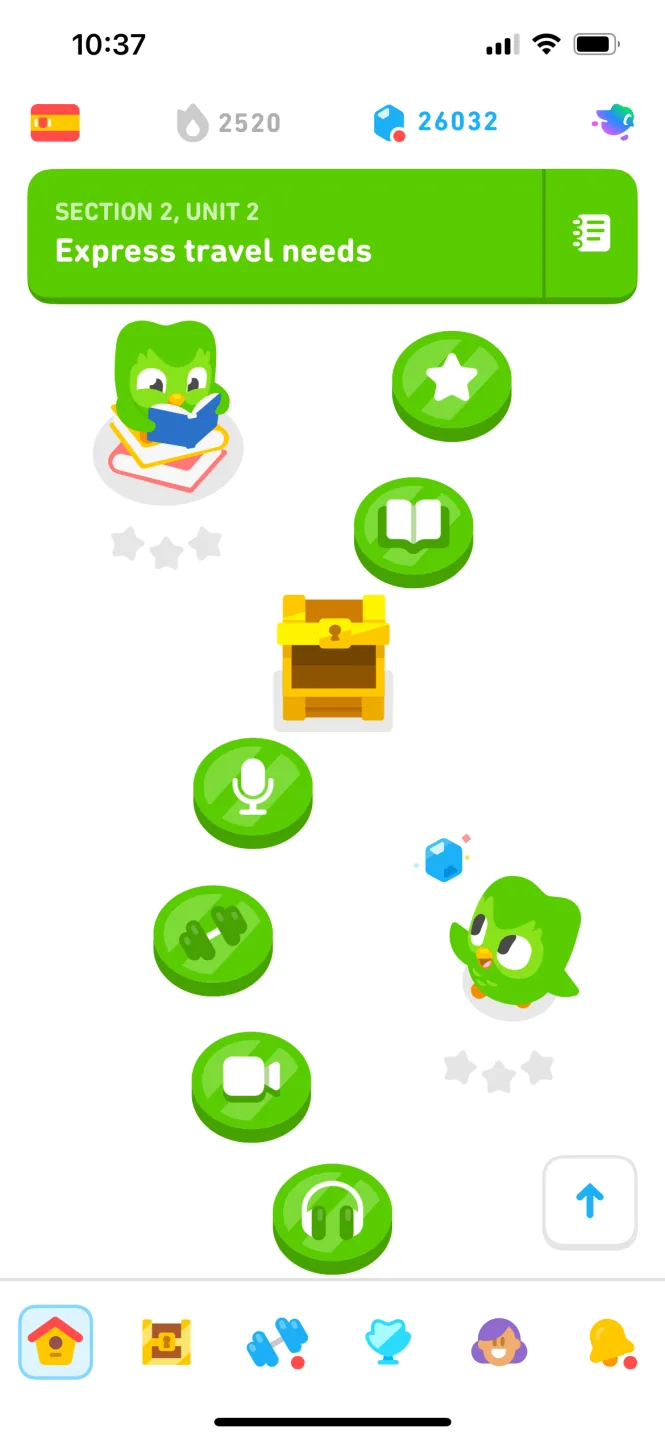
[Duolingo](https://blog.duolingo.com/duolingo-101-how-to-learn-a-language-on-duolingo/) · © Duolingo. All rights reserved. Excluded from MIT and CC BY 4.0.
1. The barbell node denotes practice
- Test retrieval by varying the context and order of tasks.
- [Duolingo](https://blog.duolingo.com/duolingo-101-how-to-learn-a-language-on-duolingo/)
## How it works
Repeat with new examples
## Variants
### Variants
- Repeat with new examples
- Recall without answers
- Revisit at intervals
- Alternate task types
- Repeat difficult elements
- Mix familiar and new
- Repeat after correction
- Apply skills in another story
- Reduce hint reliance
- Test skill stability
- Practice speed after accuracy
- Include earlier learning in composite tasks
## Design example
Reuse familiar words after several game episodes.
## Context and limits
A mechanic map for games with explicit learning goals, from first encounters with a topic to professional practice. It covers children, teenagers and adults; choose subject, difficulty, context and controls for the learner. Player actions, subject content, instructional support and assessment are distinct layers. Scores and game completion alone do not establish mastery or skill transfer.
## Connected materials
## Sources and provenance
Educational reference expanded from all 64 families and 749 variants of the original children-education taxonomy, with original editorial additions dated 2026-10-20. Sources support specific methods and examples, not the entire classification or its effectiveness.
- [Dunlosky et al. Improving Students’ Learning With Effective Learning Techniques](https://doi.org/10.1177/1529100612453266) (id: source-5f6045c885ac4c8c)
- [Duolingo](https://blog.duolingo.com/duolingo-101-how-to-learn-a-language-on-duolingo/) (id: source-872a30e434db6d16)
CC-BY-4.0 · gamemechanics.pro contributors