---
key: mechanic/education--family-42
type: mechanic
id: education--family-42
lang: en
title: Foreign languages and language switching
summary: >-
The learner links meaning, pronunciation and spelling in another language and
applies them in a meaningful context.
updatedAt: '2026-10-22'
status: active
url: 'https://gamemechanics.pro/en/knowledge/mechanic/education--family-42/'
jsonUrl: >-
https://gamemechanics.pro/api/v1/knowledge/en/mechanic/education--family-42.json
markdownUrl: >-
https://gamemechanics.pro/content/knowledge/en/mechanic/education--family-42.md
aliases:
- Foreign-language learning
tags:
- Educational games
- Language and subject applications
sourceIds:
- source-872a30e434db6d16
sources:
- id: source-872a30e434db6d16
title: Duolingo
url: >-
https://blog.duolingo.com/duolingo-101-how-to-learn-a-language-on-duolingo/
verifiedAt: null
relations: []
placements:
- catalogId: education
id: family-42
title: Educational games
url: 'https://gamemechanics.pro/en/mechanics/education/#family-42'
categoryIds:
- language
supersededBy: []
attributes:
preview:
updatedAt: '2026-10-22'
title: Foreign-language learning
description: >-
The learner links meaning, pronunciation and spelling in another language
and applies them in a meaningful context.
image:
src: images/mechanics/learning-duo-101-4.webp
width: 665
height: 1440
game: Duolingo
sourceUrl: >-
https://blog.duolingo.com/duolingo-101-how-to-learn-a-language-on-duolingo/
originalUrl: >-
https://s3.us-east-1.amazonaws.com/content.duolingo.com/Duolingo+101%3A+How+to+learn+a+language+on+Duolingo/6-exerciseTypes.png
credit: Duolingo
rights: © Duolingo. All rights reserved. Excluded from MIT and CC BY 4.0.
caption: 'Duolingo: a picture and word in a translation task'
alt: 'Duolingo: a picture and word in a translation task'
markers:
- x: 50
'y': 42
label: The fish picture links the word to its referent
tips:
- 'Alternate recognition, production and conversational use.'
examples:
- title: Duolingo
url: >-
https://blog.duolingo.com/duolingo-101-how-to-learn-a-language-on-duolingo/
endsAt: null
provenance: >-
Educational reference expanded from all 64 families and 749 variants of the
original children-education taxonomy, with original editorial additions dated
2026-10-20. Sources support specific methods and examples, not the entire
classification or its effectiveness.
license: CC-BY-4.0
codeLicense: MIT
attribution: gamemechanics.pro contributors
catalogKey: catalog/education
---
# Foreign languages and language switching
id: education--family-42
type: mechanic
key: mechanic/education--family-42
lang: en
status: active
url: https://gamemechanics.pro/en/knowledge/mechanic/education--family-42/
The learner links meaning, pronunciation and spelling in another language and applies them in a meaningful context.
## At a glance
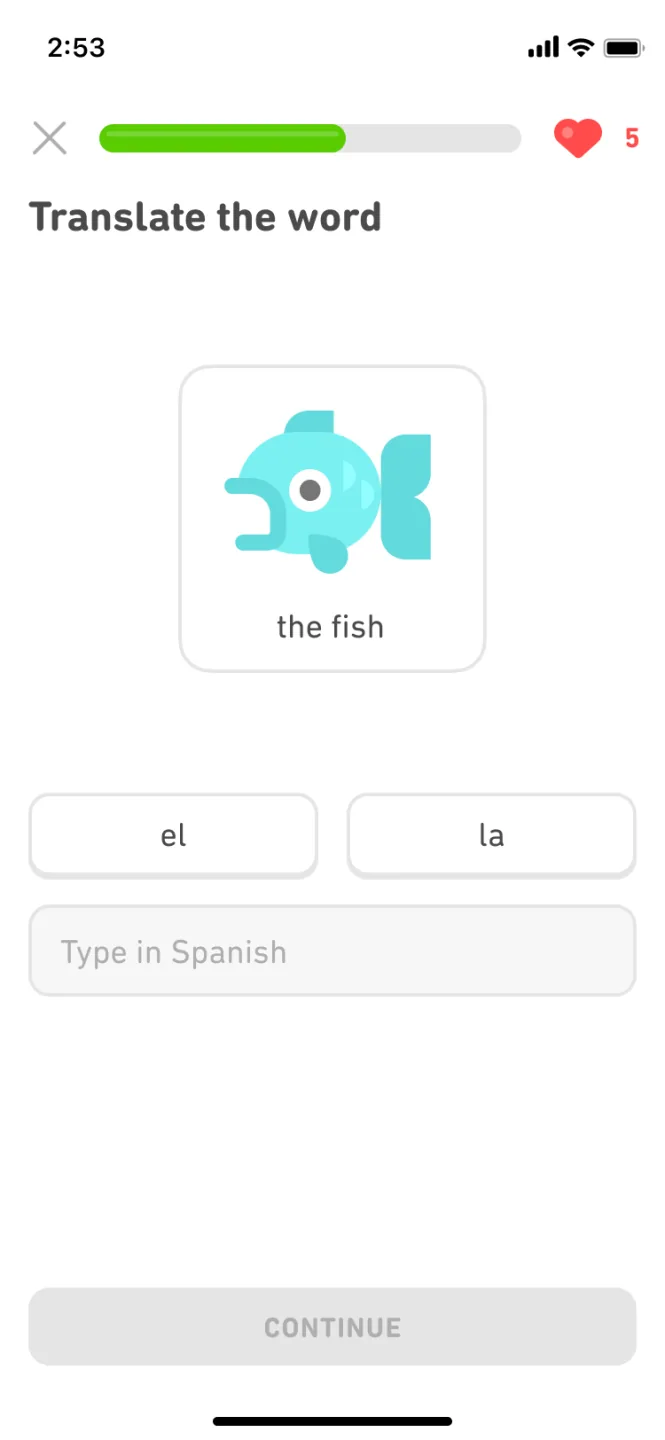
[Duolingo](https://blog.duolingo.com/duolingo-101-how-to-learn-a-language-on-duolingo/) · © Duolingo. All rights reserved. Excluded from MIT and CC BY 4.0.
1. The fish picture links the word to its referent
- Alternate recognition, production and conversational use.
- [Duolingo](https://blog.duolingo.com/duolingo-101-how-to-learn-a-language-on-duolingo/)
## How it works
Match words, sounds and images
## Variants
### Variants
- Match words, sounds and images
- Understand another language's instructions
- Recall words without translation prompts
- Pronounce words or phrases
- Use expressions in dialogue
- Switch language on cue
- Assemble utterances
- Read short messages
- Understand contextual speech
- Compare language structures
- Explain unfamiliar words using known words
- Solve through communication
## Design example
Order in a virtual cafe using the language being learned.
## Context and limits
A mechanic map for games with explicit learning goals, from first encounters with a topic to professional practice. It covers children, teenagers and adults; choose subject, difficulty, context and controls for the learner. Player actions, subject content, instructional support and assessment are distinct layers. Scores and game completion alone do not establish mastery or skill transfer.
## Connected materials
## Sources and provenance
Educational reference expanded from all 64 families and 749 variants of the original children-education taxonomy, with original editorial additions dated 2026-10-20. Sources support specific methods and examples, not the entire classification or its effectiveness.
- [Duolingo](https://blog.duolingo.com/duolingo-101-how-to-learn-a-language-on-duolingo/) (id: source-872a30e434db6d16)
CC-BY-4.0 · gamemechanics.pro contributors