---
key: mechanic/education--family-17
type: mechanic
id: education--family-17
lang: en
title: Quantity and number relationships
summary: >-
The learner works with quantity, order and numerical relationships by
counting, comparing and finding equivalent groups.
updatedAt: '2026-10-22'
status: active
url: 'https://gamemechanics.pro/en/knowledge/mechanic/education--family-17/'
jsonUrl: >-
https://gamemechanics.pro/api/v1/knowledge/en/mechanic/education--family-17.json
markdownUrl: >-
https://gamemechanics.pro/content/knowledge/en/mechanic/education--family-17.md
aliases: []
tags:
- Educational games
- 'Quantity, investigation and systems'
sourceIds:
- source-19446e425a9a00b3
- source-5b737ba9e639da22
sources:
- id: source-19446e425a9a00b3
title: '2048'
url: 'https://github.com/gabrielecirulli/2048'
verifiedAt: null
- id: source-5b737ba9e639da22
title: '2048'
url: 'https://play2048.co/'
verifiedAt: null
relations: []
placements:
- catalogId: education
id: family-17
title: Educational games
url: 'https://gamemechanics.pro/en/mechanics/education/#family-17'
categoryIds:
- systems
supersededBy: []
attributes:
preview:
updatedAt: '2026-10-22'
title: Quantity and number relationships
description: >-
The learner works with quantity, order and numerical relationships by
counting, comparing and finding equivalent groups.
image:
src: images/mechanics/systems-2048-original.webp
width: 500
height: 694
game: '2048'
sourceUrl: 'https://github.com/gabrielecirulli/2048'
originalUrl: 'https://github.com/gabrielecirulli/2048/blob/master/index.html'
credit: >-
Gabriele Cirulli; screenshot of the unmodified original game, captured
2026-10-22
rights: >-
© 2014 Gabriele Cirulli, MIT License. Screenshot converted to WebP on
2026-10-22. License copy: images/mechanics/2048-license.txt.
caption: The original 2048 after a sequence of normal moves
alt: The original 2048 after a sequence of normal moves
markers:
- x: 86
'y': 55
label: Adjacent twos can be merged into a four
tips:
- Link number symbols to observable quantities or transformations.
examples:
- title: '2048'
url: 'https://play2048.co/'
- title: Original source
url: 'https://github.com/gabrielecirulli/2048'
endsAt: null
provenance: >-
Educational reference expanded from all 64 families and 749 variants of the
original children-education taxonomy, with original editorial additions dated
2026-10-20. Sources support specific methods and examples, not the entire
classification or its effectiveness.
license: CC-BY-4.0
codeLicense: MIT
attribution: gamemechanics.pro contributors
catalogKey: catalog/education
---
# Quantity and number relationships
id: education--family-17
type: mechanic
key: mechanic/education--family-17
lang: en
status: active
url: https://gamemechanics.pro/en/knowledge/mechanic/education--family-17/
The learner works with quantity, order and numerical relationships by counting, comparing and finding equivalent groups.
## At a glance
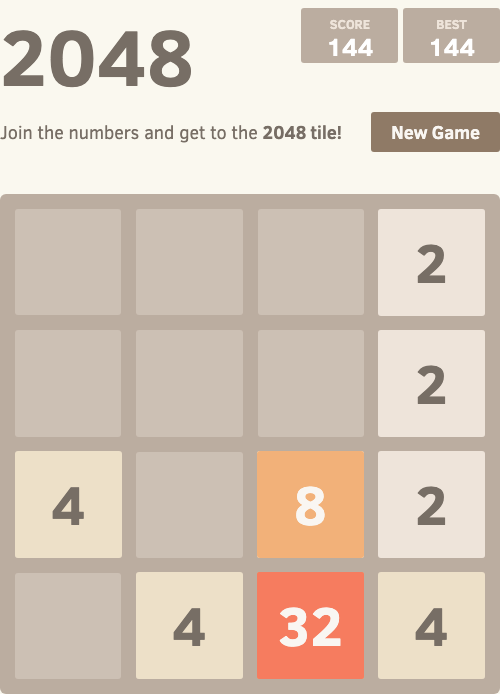
[2048](https://github.com/gabrielecirulli/2048) · © 2014 Gabriele Cirulli, MIT License. Screenshot converted to WebP on 2026-10-22. License copy: images/mechanics/2048-license.txt.
1. Adjacent twos can be merged into a four
- Link number symbols to observable quantities or transformations.
- [2048](https://play2048.co/)
- [Original source](https://github.com/gabrielecirulli/2048)
## How it works
Count objects individually
## Variants
### Variants
- Count objects individually
- Count groups
- Recognize small quantities without counting
- Establish one-to-one correspondence
- Count out a required quantity
- Compare sets
- Find number compositions
- Move along a number line
- Work with place value
- Represent fractions
- Relate fractions, decimals and percentages
- Work with negative numbers
## Design example
Give each character one item and identify the remainder.
## Context and limits
A mechanic map for games with explicit learning goals, from first encounters with a topic to professional practice. It covers children, teenagers and adults; choose subject, difficulty, context and controls for the learner. Player actions, subject content, instructional support and assessment are distinct layers. Scores and game completion alone do not establish mastery or skill transfer.
## Connected materials
## Sources and provenance
Educational reference expanded from all 64 families and 749 variants of the original children-education taxonomy, with original editorial additions dated 2026-10-20. Sources support specific methods and examples, not the entire classification or its effectiveness.
- [2048](https://github.com/gabrielecirulli/2048) (id: source-19446e425a9a00b3)
- [2048](https://play2048.co/) (id: source-5b737ba9e639da22)
CC-BY-4.0 · gamemechanics.pro contributors