---
key: mechanic/deck-building--family-play
type: mechanic
id: deck-building--family-play
lang: en
title: Play costs and methods
summary: >-
Playing a card spends a limited turn resource. The player weighs cost against
effect and chooses actions that fit the budget.
updatedAt: '2026-10-21'
status: active
url: 'https://gamemechanics.pro/en/knowledge/mechanic/deck-building--family-play/'
jsonUrl: >-
https://gamemechanics.pro/api/v1/knowledge/en/mechanic/deck-building--family-play.json
markdownUrl: >-
https://gamemechanics.pro/content/knowledge/en/mechanic/deck-building--family-play.md
aliases:
- Card costs and energy
tags:
- Deck building
- Card operations
sourceIds:
- source-c7e358f5e5763ea0
- source-7f09c8a736762f4f
sources:
- id: source-c7e358f5e5763ea0
title: 'Dune: Imperium · designer''s diary'
url: >-
https://news.direwolfdigital.com/dune-imperium-designer-diary-1-beginnings/
verifiedAt: null
- id: source-7f09c8a736762f4f
title: Slay the Spire
url: 'https://www.megacrit.com/press-kits/slay-the-spire/'
verifiedAt: null
relations: []
placements:
- catalogId: deck-building
id: family-play
title: Deck building
url: 'https://gamemechanics.pro/en/mechanics/deck-building/#family-play'
categoryIds:
- section-2
supersededBy: []
attributes:
preview:
updatedAt: '2026-10-21'
title: Card costs and energy
description: >-
Playing a card spends a limited turn resource. The player weighs cost
against effect and chooses actions that fit the budget.
image:
src: images/mechanics/slay-the-spire-battle.webp
width: 1440
height: 810
game: Slay the Spire
sourceUrl: 'https://www.megacrit.com/press-kits/slay-the-spire/'
originalUrl: 'https://www.megacrit.com/images/ss8.jpg'
credit: Mega Crit
rights: © Mega Crit. All rights reserved.
caption: Card cost and available energy
alt: >-
Slay the Spire: one energy remains on the left and the selected card
costs one energy.
markers:
- x: 11
'y': 82
label: Energy remaining this turn
- x: 43
'y': 63
label: The selected card’s cost
tips:
- Show the remaining resource and the cost at the same time.
- Explain why an unavailable card cannot be played.
examples:
- title: Slay the Spire
url: 'https://www.megacrit.com/press-kits/slay-the-spire/'
endsAt: null
provenance: >-
Original editorial design catalog consolidated from project discussions on
2026-10-20. Complete discussion item lists and contextual limitations are
preserved; linked primary sources support specific techniques, not the entire
classification. English translation was prepared with machine assistance and
editorial review.
license: CC-BY-4.0
codeLicense: MIT
attribution: gamemechanics.pro contributors
catalogKey: catalog/deck-building
---
# Play costs and methods
id: deck-building--family-play
type: mechanic
key: mechanic/deck-building--family-play
lang: en
status: active
url: https://gamemechanics.pro/en/knowledge/mechanic/deck-building--family-play/
Playing a card spends a limited turn resource. The player weighs cost against effect and chooses actions that fit the budget.
## At a glance
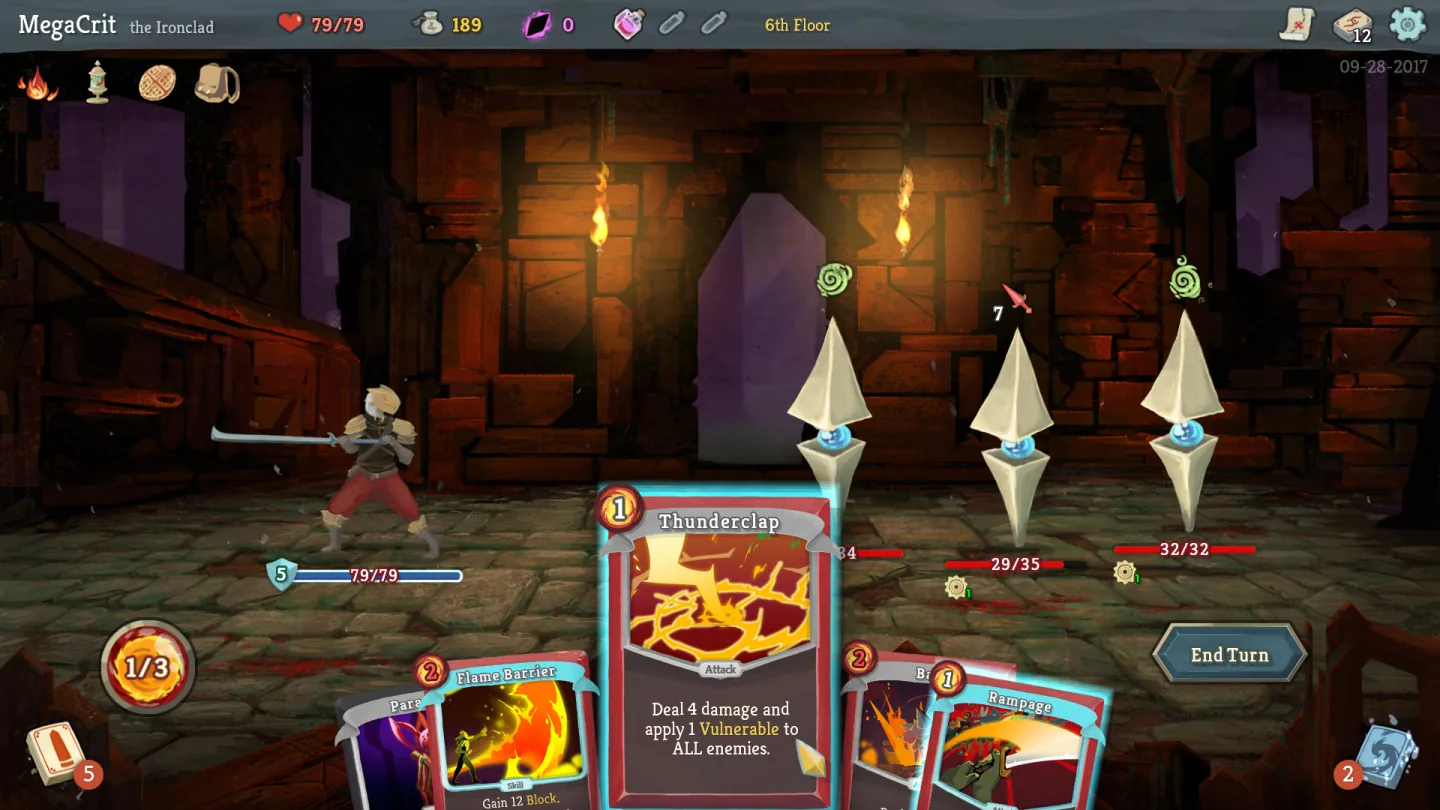
[Slay the Spire](https://www.megacrit.com/press-kits/slay-the-spire/) · © Mega Crit. All rights reserved.
1. Energy remaining this turn
2. The selected card’s cost
- Show the remaining resource and the cost at the same time.
- Explain why an unavailable card cannot be played.
- [Slay the Spire](https://www.megacrit.com/press-kits/slay-the-spire/)
## How it works
What restrictions determine how many cards can be applied and in what way.
## Variants
### Variants and applications
- Energy / mana. Rule: Cards spend their total energy, mana, or other renewable resource.
- Resource ramp / banking. Rule: Cards increase available energy, maximum reserve, or allow you to save an unused resource between turns.
- Overload / resource debt. Rule: An additional resource is available now at the cost of reduced opportunities in the next turn or another future period.
- Action economy. Rule: The number of plays is limited by the individual actions that cards can spend and perform.
- Type play limit. Rule: The rules allow a limited number of attacks, spells, or other categories per turn.
- Alternate cost. Rule: The card is allowed to be paid in different ways, such as energy, health, discard or sacrifice of another card.
- X-cost. Rule: The player chooses the amount of invested resource; the scale of the effect depends on the payment.
- Kicker / overpay. Rule: A card can be played at the base price or you can pay extra for an additional effect.
- Conditional free play. Rule: After a certain action or when a condition is met, the card stops requiring regular payment.
- Modal card. Rule: When cast, the player chooses one of the card's alternative functions.
- Pitch / dual-use. Rule: A card can be spent to pay for another card or produce a resource instead of its main effect.
- Off-hand play. Rule: A card can be used from the top of the deck, from the discard pile, from the reserve, or from the temporary exception.
- Autoplay. Rule: The effect applies the card without the player's normal selection, sometimes with automatic target selection.
- Reaction / interrupt. Rule: A card is used in response to an event, an enemy action, or another player's move.
## Context and limits
Design taxonomy of basic rules and options, including card operations and external systems. The number of entries is not a generally accepted classification of independent mechanics.
## Connected materials
## Sources and provenance
Original editorial design catalog consolidated from project discussions on 2026-10-20. Complete discussion item lists and contextual limitations are preserved; linked primary sources support specific techniques, not the entire classification. English translation was prepared with machine assistance and editorial review.
- [Dune: Imperium · designer's diary](https://news.direwolfdigital.com/dune-imperium-designer-diary-1-beginnings/) (id: source-c7e358f5e5763ea0)
- [Slay the Spire](https://www.megacrit.com/press-kits/slay-the-spire/) (id: source-7f09c8a736762f4f)
CC-BY-4.0 · gamemechanics.pro contributors